Australian National Budgerigar Council


Colour Standards By Ron Hunt
Colour Standards – A Reflection
By Ron Hunt
Looking back to 1984, New South Wales was still operating under the 50–50 Standard. Those were different days — days when colour itself carried real prestige. At the Sydney shows, you might see 15 Normal Greens (Light Greens), 8 or 9 Laurels (Dark Greens), and perhaps 5 or 6 Olives competing fiercely for their place on the bench.
The three class winners would then compete for Best Normal Green in Show. It felt almost like football — each colour its own team. If a Laurel or an Olive claimed Best Green Series, the supporters of that colour celebrated as though they had won a grand final. There was pride, passion and healthy rivalry between the shades.
The same spirit lived in the Blue Series.
Many exhibitors truly specialised — Laurel (Dark Green), Violet, Cobalt — dedicating their studs to perfecting one colour. That focus was one of the reasons entries were far stronger than we see today.
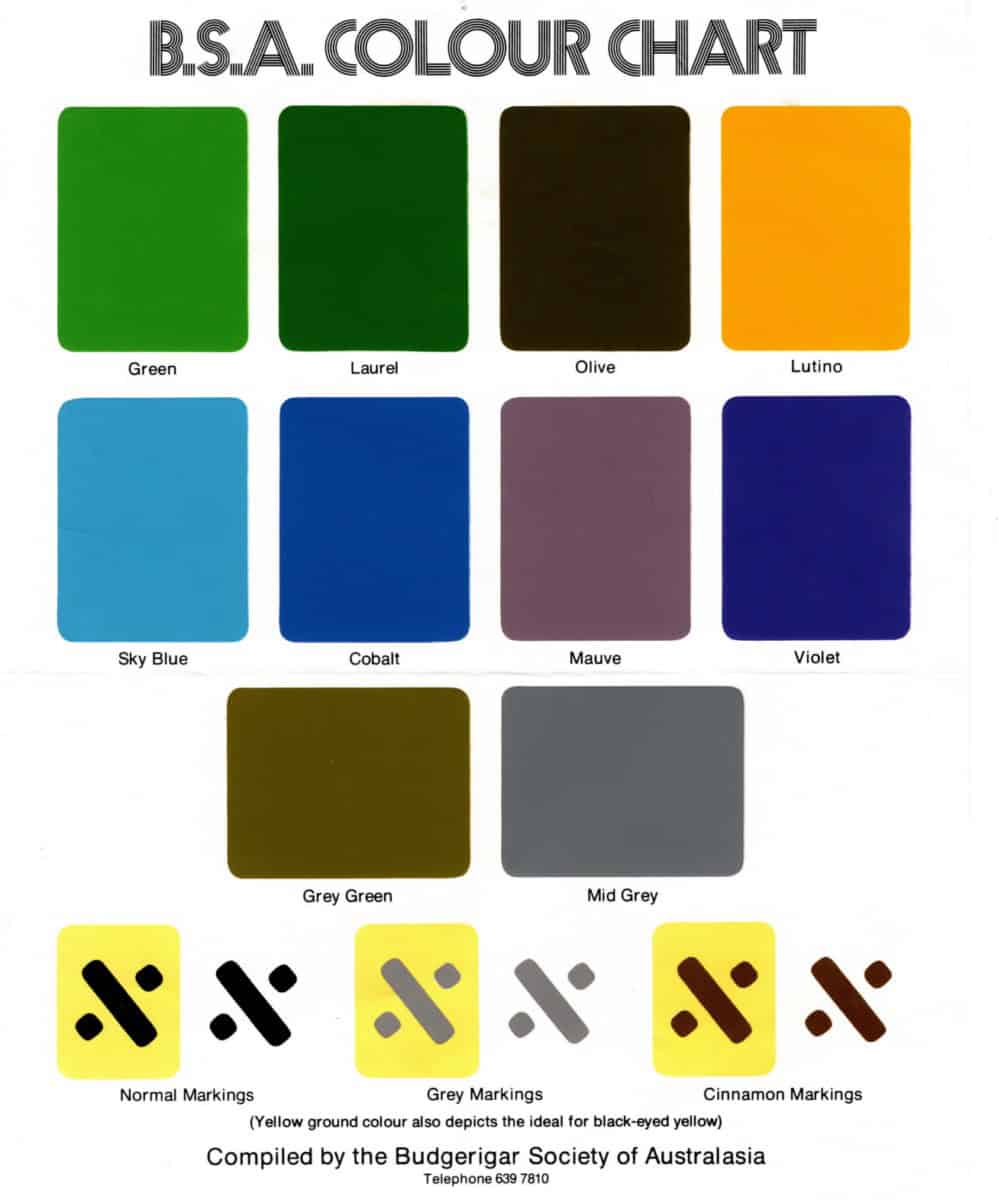
In those years, the B.S.A. formed a committee to establish a colour chart for a formal show standard. Their aim was clear: to define colours breeders could strive toward. Genetics, as we understand it now, was not as widely known then. The committee selected colours they believed represented ideals, but some of these were not embraced by specialist breeders.
The reality is that our colours are essentially a darkening of the Light Green or Sky Blue. When we move beyond those base colours, the effect changes entirely. The Dark Green is simply Light Green with obstruction in the light rays passing through the feather — the same principle applies to other variations.
There was also misunderstanding around the Inos. A Lutino is, in fact, a green bird masked by a yellow “glove,” while an Albino is a blue bird covered by a white one. Many breeders were surprised when outcrossing revealed unexpected Greens. Likewise, Greys and Grey Greens were often treated as a single colour, when in reality they represent Dark Green or Olive carrying the grey factor. That grey factor is again about light obstruction within the feather — meaning multiple shades can technically be correct, depending on the base colour being diluted.
This is not criticism of the 1982 B.S.A. colour standards committee. They worked earnestly and established 20 leagues that shaped colour exhibition for years to come.
I myself specialised in Olives and was fortunate to win Best Olive in Show at the B.S.A. Annual Show on many occasions. Today, I admit to feeling disappointed that this award no longer exists. Perhaps its absence is reflected in the entries — sometimes only one Olive, sometimes none at all.
Those were spirited times — when colour meant allegiance, pride and friendly rivalry. It is a chapter of our hobby worth remembering.
Ron Hunt