Australian National Budgerigar Council


G J Callister
The Aviary: A Legacy of Birds and Family
Geoff & Jill Callister, Hamilton, New Zealand
Origins of The Aviary
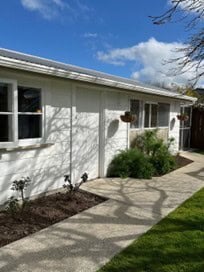
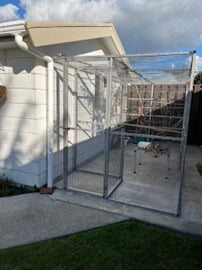
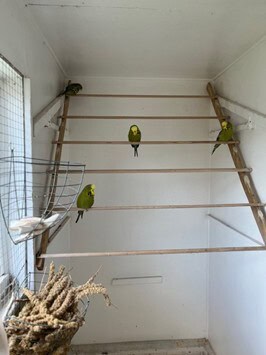
When Geoff and Jill Callister built their new home in Hamilton in 1971, they ensured that the “garden shed” was officially designated as an aviary. It measured 4 m x 4.5 m, with the same roofline and exterior materials as the house. It was designed to hold up to 60 to 70 canaries or budgerigars. Outfitted with 2 internal flights, a breeding room, and later an external flight (4m X 2m – upgraded in 2010 with aluminium frame and new wire), the aviary quickly became the heart of their bird-keeping life.
The external flight put up in 1972, was transported from Geoff’s aviary complex at his family home. This aviary complex (breeding room, external flights etc) was built for him in 1956 by his grandfather. The complex had space for the keeping of a wide variety of birds. Some of them were budgerigars, canaries, finches, love birds, cockatiels, and pheasants.
A utility room extension brought the total footprint to approximately 4 m x 10.5 m. This extension provided space for show cages and equipment. Power was connected, though water was overlooked — a lesson learned the hard way.
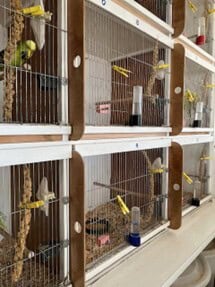
Initially, provision was made for 8 breeding cages. Some years later this finally increased to 15 cages. In 2019 the number of birds kept was reduced from about 70 to 35. Six to eight breeding cages are now used.
 |
 |
 |
 |
The Canary Years
Initially, the aviary housed non-colour fed canaries, particularly red factor and apricot varieties. The layout proved ideal, and by 1980 Geoff and Jill had achieved Champion exhibitor status. For nearly a decade, the aviary was synonymous with canary excellence.
A Return to Budgerigars
By the mid-1980s, the Callisters shifted focus back to budgerigars. Canaries are nice but children seem to have an attraction to budgerigars. Or is it the other way round! So, in the mid-1980’s, it was out with the canaries and back to budgerigars. However, not before a bit of a diversion.
The aviary is capable to being closed and temperature controlled – just the right thing for sensitive foreign finches. Gouldians settled in nicely, built nests, laid eggs, hatched chicks and then disaster! The neighbour sprayed his garden weeds on a windy day. The result: chicks and their very expensive and hard to replace parents all dead.
It was back to Budgerigars.
Sourcing budgerigars (the ones they wanted) in the mid-1980s turned out to be difficult. In fact, it was very difficult. Having obtained Champion exhibition status as a canary exhibitor meant that if they wanted to exhibit another variety of bird, they would be classed as a Champion.
Weeks turned into months and then their luck changed. On a family trip to the Auckland Zoo, they called into a budgerigar show in a suburb close by. There, they met Terry Patten.
The following week they made another trip to Auckland to see Terry and Linda and left with six budgerigars. They were back in budgies.
At the time they were not to know the unparalleled value that Terry and Linda were to add to the development of the NZ exhibition budgerigar and the hobby in general.
 |
 |
 |
The 1994 Importation
A landmark moment arrived in 1994, when English budgerigars were imported into New Zealand. Geoff and Jill joined a four-family syndicate, receiving four birds purchased on their behalf by the Pattens.
In preparation for the receipt of the syndicate birds several steps were taken: their aviary was closed to outsiders for one year before arrival until the final distribution. The distribution was to the syndicate parties. Except for their red eyes, which would be used as feeders, all other birds were sold. A vet, who just happened to be their neighbour at the time, was involved throughout the process.
It was decided that the four syndicate birds would be bred in their aviary, as two pairs. Then, after a “breeding season or two,” they would be divided equally between the four parties.
The Callisters’ aviary, as mentioned, became the breeding ground for the syndicate stock. Strict biosecurity measures were put in place. The birds bred exceptionally well, and within 18 months all four parties had a good number of birds. This created strong foundations for their own lines. These imports remain central to the Callisters’ breeding program today.
Partnership and Legacy
Over the years, outcrosses from the Patten aviary proved highly compatible. When Terry retired in 2023, Geoff and Jill were fortunate to receive several of his birds. This gift continues to enrich their breeding results.
Terry and Linda’s retirement marked the end of an era. However, their influence endures. Today, they devote their time to raising puppies for Mobility Dogs NZ. Meanwhile, their avian legacy lives on in aviaries across the country.
The Future
Now in its 53rd year of continuous use, The Aviary stands as a testament to dedication, resilience, and passion. Its future is uncertain — perhaps one day it will be re-designated as a “garden shed.” Nevertheless, its story, woven through generations of birds and friendships, ensures that The Aviary will always be remembered as more than just a building.
It is a living heritage of New Zealand’s bird fancying tradition.