Australian National Budgerigar Council


History of the Standard
The History of “The ANBC Standard”
The development of “The Standard” remains one of the most defining milestones in the history of the Australian Budgerigar Fancy. Built through collaboration, debate, and vision, it represents decades of dedication from fanciers across the country.
Preserving the Foundations
The documents presented here reflect the collective work of many dedicated fanciers who contributed to shaping “The Standard” into what it is today.
These early pictorials, scales of points, and written definitions form an important part of our history — one that must be preserved for future generations of breeders and judges.
“It is important that the history of ‘The Standard’ be preserved — and that the efforts of those who built it are never forgotten.”
Nigel Tonkin
President, BCSA
23 March 2008
The Organisations Behind the Standard
The journey towards a unified standard involved collaboration across multiple governing bodies, including:
- The Budgerigar Council of Victoria (formerly BCA)
- The Budgerigar Society of New South Wales (formerly BSA)
- Western Australia Budgerigar Council
- The Budgerigar Council of South Australia (formerly BSSA)
Each contributed ideas, interpretations, and direction that ultimately helped shape the national framework we recognise today.
FOREWORD — The Need for a National Standard
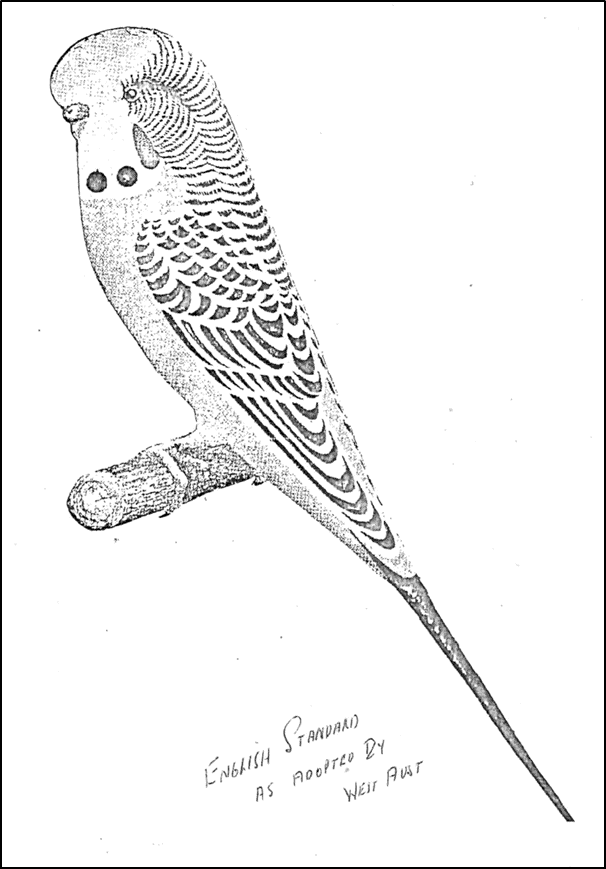
For many years, Interstate Championship Competitions were judged under a mix of standards — including B.C.A., B.S.A., and English interpretations.
While the competitions continued to grow in success, this lack of uniformity presented clear challenges.
The formation of the Australian National Budgerigar Council marked a turning point — but without a unified standard, the organisation lacked consistency in judging.
“Without a set of standards to judge its competitions, the A.N.B.C. lacks teeth.”
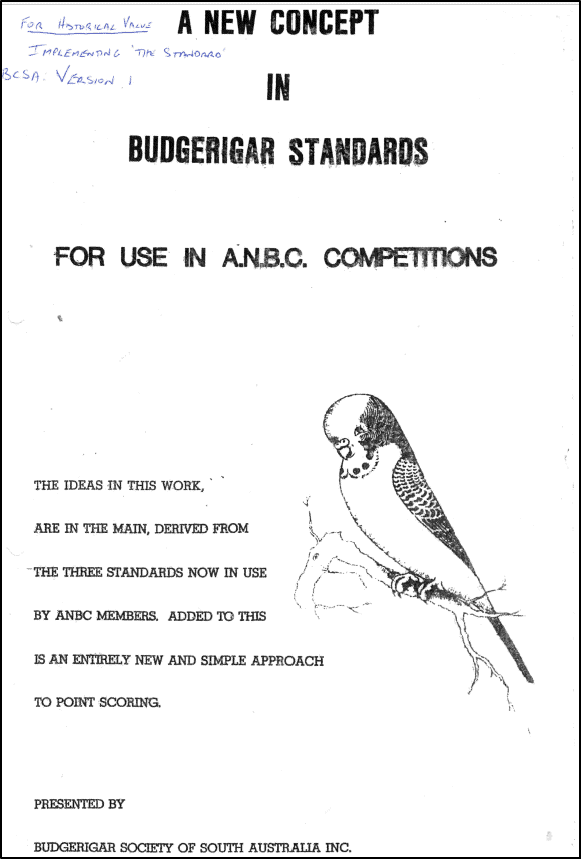
Following the rejection of a proposal to adopt the English Standard, South Australia took the initiative to lead the development of a new national framework.
The 1982–1983 Breakthrough
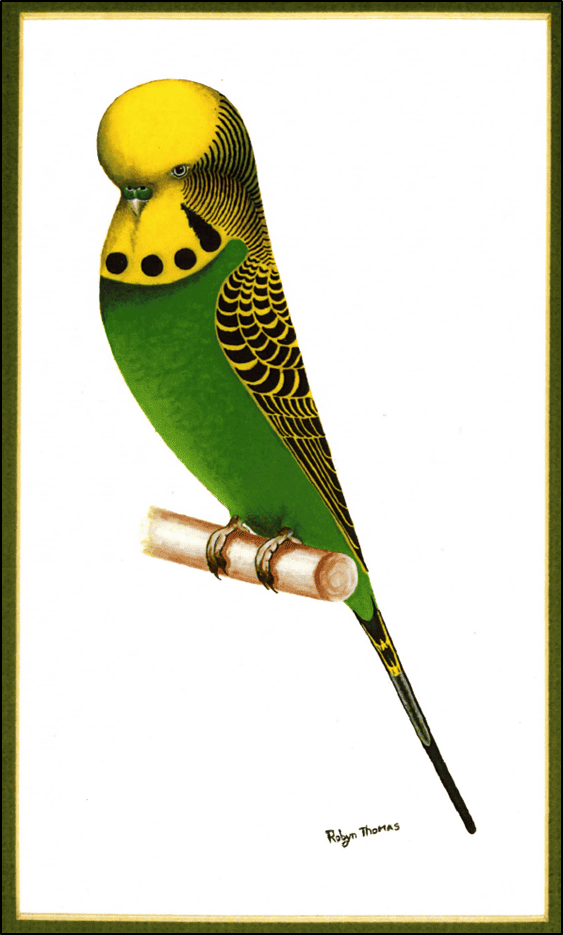
In August 1982, a sub-committee of five senior judges and breeders was formed to create a complete new set of standards.
Their brief included:
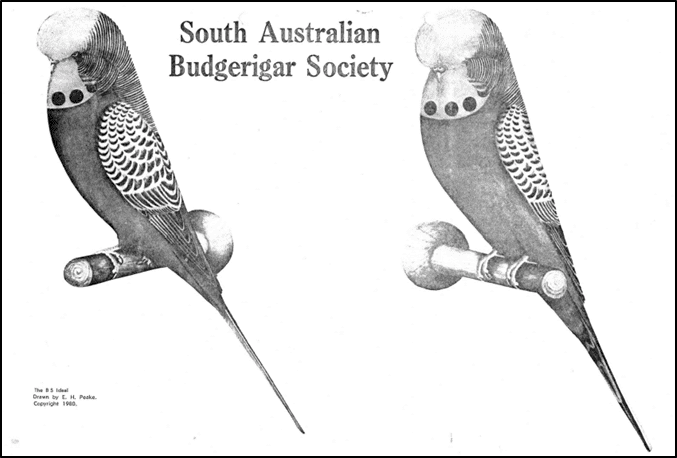
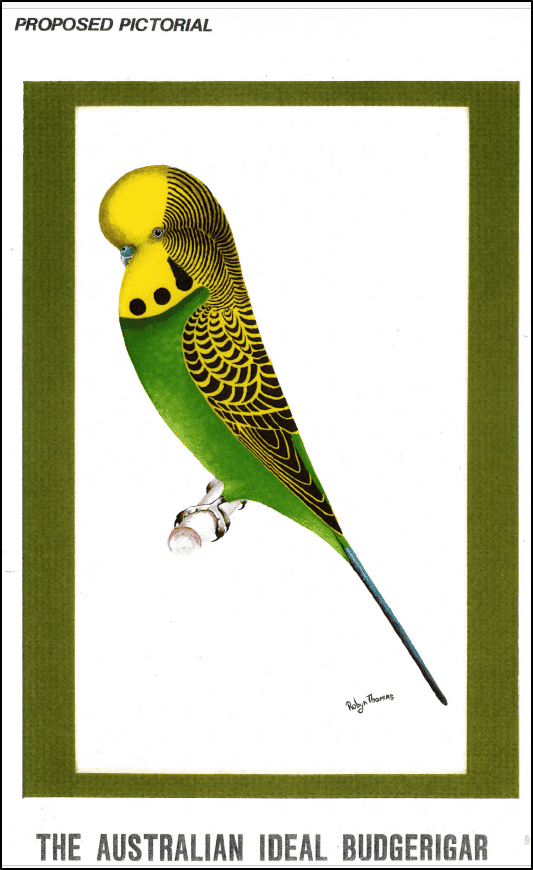
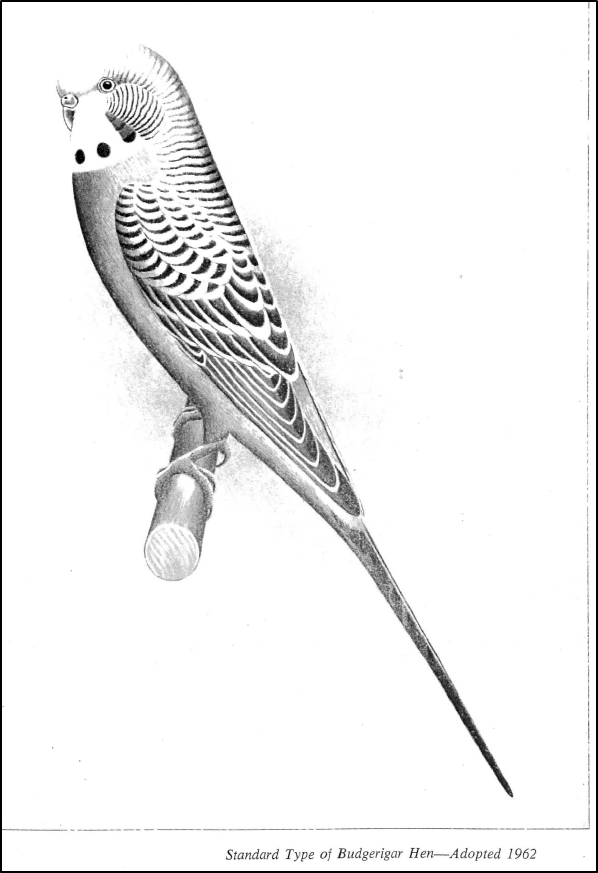
- Defining the Ideal Bird
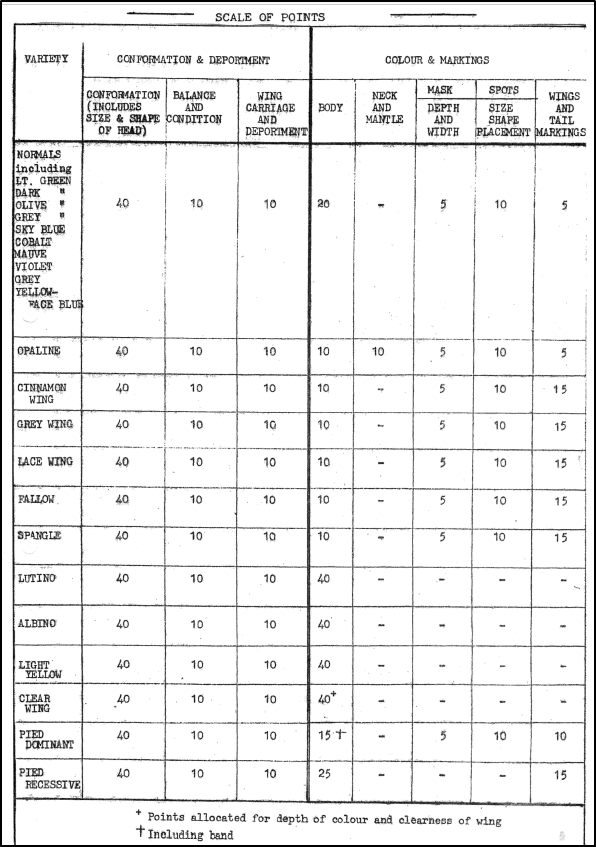
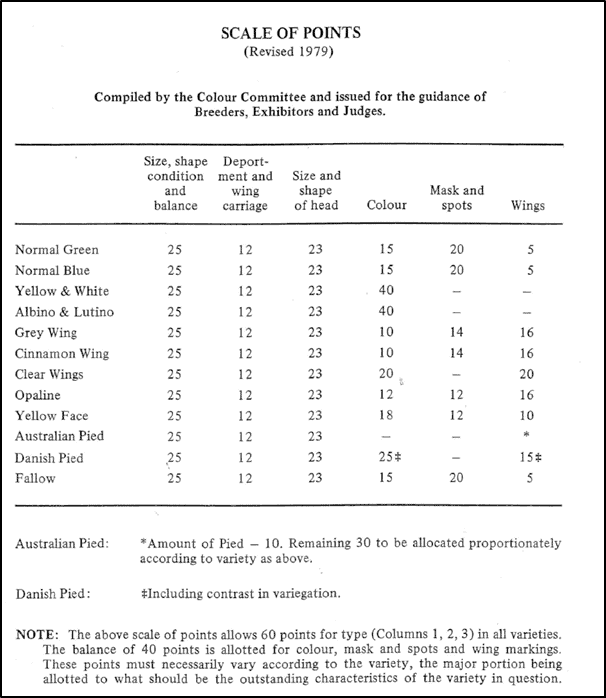
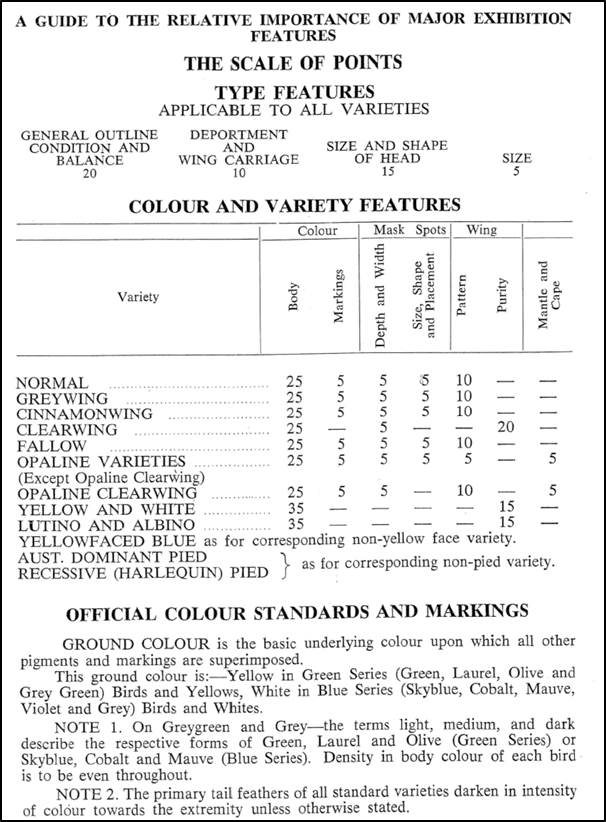
- Establishing a Scale of Points
- Producing written definitions for each variety
- Ensuring fairness across all States
By March 1983, the work was completed and ratified with only minor amendments.
These proposals were then submitted to the ANBC as a National Standard for Interstate Competition.
Special Standards Committee:
G. Duffield, R. Hancock, K. Kakoschke, G. Lowe, G. J. Smith
Artist: Robyn Thomas
A Vision for Unity
Importantly, the proposed standard was not intended to replace individual State standards immediately.
Instead, it aimed to create a unified direction — one that would eventually bring all States under a single, consistent framework.
This vision was grounded in three key outcomes:
- Stability in judging
- Uniformity across competitions
- Greater credibility on the international stage
“A National Standard will bring stability, uniformity, and credibility to the Australian Budgerigar Fancy.”
George Duffield
President, Budgerigar Society of South Australia Inc.
The Proposed Colour Standards
The introduction of a unified standard also brought detailed definitions for each recognised variety, ensuring clarity and consistency in judging.
These included core varieties such as:
- Green Series — Light Green, Dark Green, Olive, Grey Green
- Yellow Series — Light, Dark, Olive, Grey Yellow
- Blue Series — Skyblue, Cobalt, Mauve, Violet, Grey
- White and Yellow forms
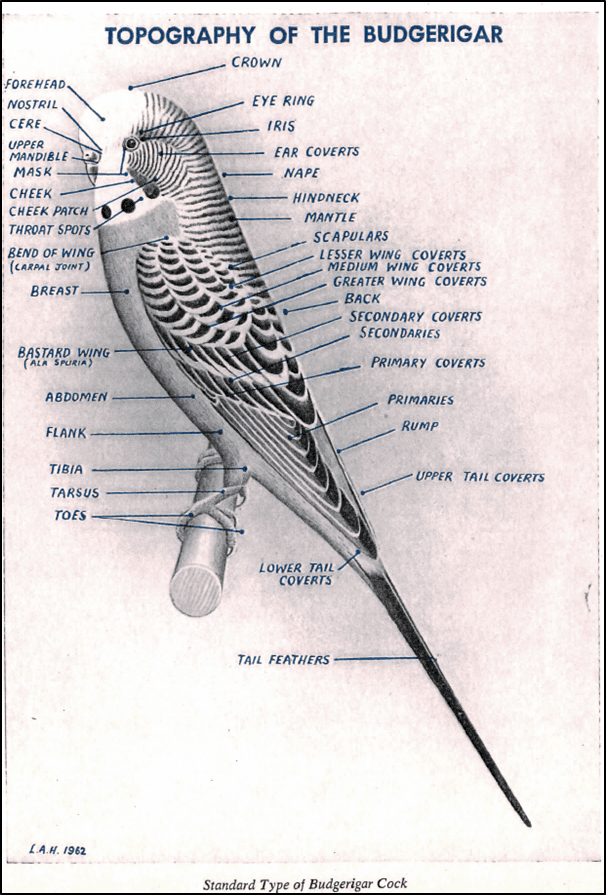
Each variety was defined through specific criteria including mask, cheek patches, body colour, markings, and tail characteristics.
From these foundations, further varieties were developed and standardised, including:
- Opaline
- Cinnamon (now referred to as Cinnamonwing in The Standard)
- Greywing
- Clearwing
- Fallow
- Lutino and Albino
- Pieds (Dominant and Recessive)
- Lacewing
- Spangle
Each carried its own detailed definition, ensuring judges across the country could assess birds with consistency and precision.
LIGHT GREEN
Mask, buttercup, ornamented by six evenly spaced large round black throat spots, the outer two being partially covered at the base by cheek patches. Cheek patches: violet. General body colour: back, rump, breast, flanks and underparts, bright grass green of a solid and even shade throughout. Markings: on cheeks, back of head, neck and wings, black and well defined on a buttercup ground. Tail: long feathers, bluish black.
DARK GREEN
As above but with a dark laurel green body colour. Tail: long feathers, darker in proportion.
OLIVE GREEN
As above but with a deep olive green body colour. Tail: long feathers, darker in proportion.
GREY GREEN
The Grey Green conforms to the standard for Light Green except in the following details. Cheek patches: grey to slate. General body colour: dull mustard green. Tail: long feathers, black. (It should be noted that there are light, medium and dark shades of Grey Green.)
LIGHT YELLOW
Mask, buttercup. Cheek patches: silvery white to pale pinkish violet. General body colour: back, rump, breast, flanks and underparts, deep buttercup yellow and as free from green suffusion as possible. Primaries and tail: lighter than body. Eye: black pupil with white iris.
DARK YELLOW
Same as above but correspondingly deeper in colour.
OLIVE YELLOW
As above but with a mustard body colour.
GREY YELLOW
As above but with a dull mustard body colour. (It should be noted that there are light, medium and dark shades of Grey Yellow.)
SKYBLUE
Mask: clear white, ornamented by six evenly spaced large round black throat spots, the outer two being partially covered at the base by cheek patches. Cheek patches: violet. General body colour: back, rump, breast flanks and underparts, pure skyblue. Markings: on cheeks, back of head, neck and wings, black and well-defined on a white ground. Tail: long feathers, bluish black.
COBALT
As above but with a deep rich cobalt blue body colour. Tail: long feathers, darker in proportion.
MAUVE
As above but with a purplish mauve body colour with a tendency to a pinkish tone. Tail: long feathers, darker in proportion.
VIOLET
As above but with a deep intense violet body colour. Tail: long feathers, darker in proportion.
GREY
Mask: white, ornamented by six evenly spaced large round black throat spots, the outer two being partially covered at the base by cheek patches. Cheek patches: grey-blue or slate. General body colour: back, rump, breast, flanks and underparts, solid grey. Markings: on cheeks, back of head, neck and wings, black and well defined on a white ground. Tail: long feathers, black. (It should be noted that there are light, medium and dark shades of Grey.)
WHITE
Mask: white. General body colour: back, rump, breast, flanks and underparts, white or near white. Wings and tail: pure white. Cheek patches: pale colour of the variety they represent.
OPALINE LIGHT GREEN
Mask: buttercup, extending over back of head and merging into general body colour at a point level with the butt of wings where undulations should cease thus leaving a clear V effect between top of wings so desirable in this variety, to be ornamented by six evenly spaced large round black throat spots, the outer two being partially covered at the base by cheek patches. Cheek patches: violet. General body colour: mantle (including V area or saddle), back, rump, breast, flanks and underparts, bright grass green. Wings: to be the same colour as body. Markings: should be normal with a suffused opalescent effect. Tail: long feathers, not to be lighter than mantle.
OPALINE DARK GREEN
As above but with a dark laurel green body colour. Tail: long feathers, not to be lighter than mantle.
OPALINE OLIVE GREEN
As above but with an olive green body colour. Tail: long feathers, not to be lighter than mantle.
OPALINE GREY GREEN
As above but with a dull mustard green body colour. Tail: long feathers, not to be lighter than mantle. Cheek patches: grey to slate. (It should be noted that there are light, medium and dark shaded of Opaline Grey Green.)
OPALINE SKYBLUE
Mask: white, extending over back of head and merging into general body colour at a point level with the butt of wings where undulation should cease thus leaving a clear V effect between the top of wings so desirable in this variety, to be ornamented by six evenly spaced large round black throat spots, the outer two being partially covered at the base by cheek-patches. Cheek-patches: violet. General body colour: mantle (including V area or saddle), back, rump, breast, flanks and underparts, pure skyblue. Wings: to be the same colour as body. Markings: should be normal with a suffused opalescent effect. Tail: long feathers, not to be lighter than mantle.
OPALINE COBALT
As above but with a cobalt body colour. Tail: long feathers, not to be lighter than mantle.
OPALINE MAUVE
As above but with a mauve body colour. Tail: long feathers, not to be lighter than mantle.
OPALINE VIOLET
As above but with a deep intense violet body colour. Tail: long feathers, not to be lighter than mantle.
OPALINE GREY
As above but with a solid grey body colour. Cheek patches: grey to slate. Tail: long feathers, no lighter than mantle. (It should be noted that there are light, medium and dark shades of Opaline Grey.)
OPALINE CINNAMON LIGHT GREEN
Mask: buttercup, extending over back of head and merging into general body colour at a point level with butt of wings where undulations should cease, thus leaving a clear V effect between top of wings so desirable in this variety, to be ornamented by six evenly spaced large cinnamon brown throat spots; the outer two being partially covered at the base by cheek patches. Cheek patches: violet. General body colour: mantle (including V area or saddle), back, rump, breast, flanks and underparts, pale grass green. Wings to be same colour as body. Markings: should be normal cinnamon brown with a suffused opalescent effect. Tail: long feathers, not to be lighter than mantle.
OPALINE CINNAMON DARK GREEN
As above but with a light laurel green body colour. Tail: long feathers, not to be lighter than mantle.
OPALINE CINNAMON OLIVE GREEN
As above but with a light olive green body colour. Tail: long feathers, not to be lighter than mantle.
OPALINE CINNAMON GREY GREEN
As above but with a pale grey green body colour. Tail: long feathers, not to be lighter than mantle. Cheek patches: grey to slate. (It should be noted that there are light, medium and dark shades of Opaline Cinnamon Grey Green.)
OPALINE CINNAMON SKYBLUE
Mask: white, extending over back of head and merging into general body colour at a point level with butt of wings where undulations should cease, thus leaving a clear V effect between top of wings so desirable in this variety; to be ornamented by six evenly spaced large round cinnamon brown throat spots, the outer two being partially covered at the base by cheek patches. Cheek patches: violet. General body colour: mantle, back, rump, breast, flanks and underparts, pale skyblue. Markings: should be normal cinnamon brown on pale blue ground with suffused opalescent effect. Tail: long feathers, not to be lighter than mantle.
OPALINE CINNAMON COBALT
As above but with pale cobalt body colour. Tail: long feathers, not to be lighter than mantle.
OPALINE CINNAMON MAUVE
As above but with pale mauve body colour. Tail: long feathers, not to be lighter than mantle.
OPALINE CINNAMON VIOLET
As above, but pale violet body colour. Tail: long feathers, not to be lighter than mantle.
OPALINE CINNAMON GREY
As above but with pale grey body colour. Cheek patches: grey to slate. Tail: long feathers, not to be lighter than mantle. (It should be noted that there are light, medium and dark shades of Opaline Cinnamon Grey.)
CINNAMON LIGHT GREEN
Mask: buttercup, ornamented by six evenly spaced large round cinnamon brown throat spots, the outer two being partially covered at the base by cheek patches. Cheek patches: violet. General body colour: back, rump, breast, flanks and underparts grass green 50 percent or more of normal body colour. Markings: on cheeks, back of head, neck and wings, cinnamon brown on yellow ground and distinct as in normal colour. Tail: long feathers, dark blue with brown quill.
CINNAMON DARK GREEN
As above but with a light laurel green body colour. Tail: long feathers, darker in proportion.
CINNAMON OLIVE GREEN
As above but with a light olive green body colour. Tail: long feathers, darker in proportion.
CINNAMON GREY GREEN
As above but with a pale grey green body colour. Cheek patches: grey to slate. Tail: long feathers, of a deep cinnamon shade. (It should be noted that there are light, medium and dark shades of Cinnamon Grey Green).
CINNAMON SKYBLUE
Mask: white, ornamented by six evenly spaced large round cinnamon brown throat spots, the outer two being partially covered at the base by cheek patches. Cheek patches: violet. General body colour: back, rump, breast, flanks and underparts skyblue, 50 per cent or more of normal body colour. Markings: cheeks, back of head neck and wings cinnamon brown on white ground and distinct as in normal colour. Tail: long feathers, blue with brown quill.
CINNAMON COBALT
As above but with pale cobalt body colour. Tail: long feathers, cobalt with cinnamon shade.
CINNAMON MAUVE
As above but with pale mauve body colour. Tail: long feathers, mauve with cinnamon shade.
CINNAMON VIOLET
As above but with pale violet body colour. Tail: long feathers, violet with cinnamon shade.
CINNAMON GREY
As above but with pale grey body colour. Cheek patches: pale grey. Tail: long feathers, pale grey with cinnamon shade. (It should be noted that there are light, medium and dark shades of Cinnamon Grey.)
GREYWING LIGHT GREEN
Mask: yellow, ornamented by six evenly spaced large round grey throat spots, the outer two being partially covered at the base by cheek patches. Cheek patches: pale violet. General body colour: back, rump, breast, flanks and underparts grass green, 50 per cent or more of normal body colour. Markings: on cheek, back of head, neck and wings should be light grey and distinct as in normal colour. Tail: long feathers, grey with pale bluish tinge.
GREYWING DARK GREEN
As above but with a light laurel green body colour. Tail: long feathers, darker in proportion.
GREYWING OLIVE GREEN
As above but with a light olive green body colour. Tail: long feathers, darker in proportion.
GREYWING GREY GREEN
As above but with a light mustard green body colour. Cheek patches: light grey. Tail: long feathers, dark grey. (It should be noted that there are light, medium and dark shades of Greywing Grey Green.)
GREYWING SKYBLUE
Mask: white, ornamented by six evenly spaced large round grey throat spots, the outer two being partially covered at the base by cheek patches. Cheek patches: light violet. General body colour: back, rump, breast, flanks and underparts skyblue, 50 per cent or more of normal body colour. Markings: on cheek, back of head, neck and wings should be light grey and distinct as in normal colour. Tail: long feathers, greyish blue tinge.
GREYWING COBALT
As above but with a pale cobalt body colour. Tail: long feathers, darker in proportion.
GREYWING MAUVE
As above but with a pale mauve body colour. Tail: long feathers, darker in proportion.
GREYWING VIOLET
As above but with a pale violet body colour. Tail: long feathers, darker in proportion.
GREYWING GREY
As above but with a pale grey body colour. Cheek patches: pale grey. Tail: long feathers, dark grey. (It should be noted that there are light, medium and dark shades of Greywing Grey.)
OPALINE GREYWING LIGHT GREEN
Mask: yellow, extending over back of head and merging into general body colour at a point level with butt of wings where undulations should cease, leaving a definite V effect between top of wings so desirable in this variety, to be ornamented by six evenly spaced large round grey throat spots, the outer two being partially covered at the base by cheek patches. Cheek patches: violet. General body colour: mantle (including V area or saddle), back, rump, breast, flanks and underparts: pale grass green. Wings same colour as body. Markings should be normal and light grey in colour with suffused opalescent effect. Tail: long feathers, smoky grey.
OPALINE GREYWING DARK GREEN
As above but with a light laurel green body colour. Tail: long feathers, darker in proportion.
OPALINE GREYWING OLIVE GREEN
As above but with a light olive green body colour. Tail: long feathers, darker in proportion.
OPALINE GREYWING GREY GREEN
As above but with a light mustard body colour. Cheek patches: light grey. Tail: long feathers, dark grey. (It should be noted that there are light, medium and dark shades of Opaline Greywing Grey Green.)
OPALINE GREYWING SKYBLUE
Mask: white, extending over back of head and merging into general body colour at a point level with the butt of wings where undulations should cease, leaving a definite clear V effect between top of wings, so desirable in this variety, to be ornamented by six evenly spaced large round grey throat spots, the outer two being partially covered at the base by cheek patches. Cheek patches: violet. General body colour: mantle (including V area or saddle), back, rump, breast, flanks and underparts, pale skyblue. Wings same colour as body. Markings: should be normal and grey in colour with suffused opalescent effect. Tail: long feathers, grey.
OPALINE GREYWING COBALT
As above but with pale cobalt body colour. Tail: darker in proportion.
OPALINE GREYWING MAUVE
As above but with pale mauve body colour. Tail: darker in proportion.
OPALINE GREYWING VIOLET
As above but with pale violet body colour. Tail: darker in proportion.
OPALINE GREYWING GREY
As above but with pale grey body colour. Cheek patches: light grey
Tail: long feathers, grey. (It should be noted that there are light, medium and dark shades of Opaline Greywing Grey.)
CLEARWING LIGHT GREEN
Mask: buttercup. Cheek patches: violet. General body colour: back, rump, breast, flanks and underparts, bright grass green. Wing buttercup, as free from markings as possible. Tail: long feathers, bluish. (Note: clearwings showing opaline characteristics should be shown in the A.O.C. or V. class).
CLEARWING DARK GREEN
As above but with dark laurel green body colour. Tail: long feathers darker in proportion.
CLEARWING OLIVE GREEN
As above but with an olive green body colour. Tail: long feathers, darker in proportion.
CLEARWING GREY GREEN
This variety conforms to the standard of Clearwing Light Green except that general body colour should be dull mustard green. Cheek patches: grey to slate. Tail: long feathers, darker in proportion (It should be noted that there are light, medium and dark shades of Clearwing Grey Green.)
CLEARWING SKYBLUE
Mask: white. Cheek patches: violet. General body colour: back, rump, breast, flanks and underparts, pure skyblue approximating to the normal variety. Wings: white, as free from markings as possible. Tail: long feathers, bluish. (Note: Clearwings showing opaline characteristics should be shown in the A.O.C. or V. class.)
CLEARWING COBALT
As above but with a cobalt body colour. Tail: long feathers, darker in proportion.
CLEARWING MAUVE
As above but with a mauve body colour. Tail: long feathers, darker in proportion.
CLEARWING VIOLET
As above but with a violet body colour. Tail: long feathers, darker in proportion.
CLEARWING GREY
As above but with a grey body colour. Cheek patches: grey-blue. Tail: long feathers, grey. (It should be noted that there are light, medium and dark shades of Clearwing Grey.)
FALLOW LIGHT GREEN
Mask: yellow, ornamented by six evenly spaced large round brown throat spots, the outer two being partially covered at the base by cheek patches. Cheek patches: violet. General body colour: back, rump, breast, flanks and underparts, yellowish green. Markings on cheeks, back of head, neck and wings, medium brown on a yellow ground. Eyes: red or plum. Tail: long feathers, bluish grey.
FALLOW DARK GREEN
As above but with a light laurel green body colour. Tail: long feathers, darker in proportion.
FALLOW OLIVE GREEN
As above but with a light mustard olive green body colour. Tail: long feathers, darker in proportion.
FALLOW GREY GREEN
As above but with a dull mustard green body colour. Cheek patches: grey to slate. Tail: long feathers, darker in proportion. (It should be noted that there are light, medium and dark shades of Fallow Grey Green.)
FALLOW SKYBLUE
Mask: white, ornamented by six evenly spaced large round brown throat spots, the outer two being partially covered at base by cheek patches. Cheek patches: violet. General body colour: back, rump, breast, flanks and underparts, pale skyblue. Markings: on cheeks, back of head, neck and wings, medium brown on a white ground. Eyes: red or plum. Tail: long feathers, bluish grey.
FALLOW COBALT
As above but with a warm cobalt body colour. Tail: long feathers, darker in proportion.
FALLOW MAUVE
As above but with a pale mauve body colour of a pinkish tone. Tail: long feathers, darker in proportion.
FALLOW VIOLET
As above but with a pale violet body colour. Tail: long feathers, darker in proportion.
FALLOW GREY
As above but with a pale grey body colour. Cheek patches: grey to slate. Tail: long feathers, darker in proportion. (It should be noted that there are light, medium and dark shades of Fallow Grey.) English and German forms are recognised: the German form having a white iris ring around the eye, the English form has none.
LUTINO
Buttercup yellow throughout. Eyes: clear red with light iris ring. Cheek patches: silvery white. Tail: long feathers and primaries yellowish white.
ALBINO
White throughout. Eyes: clear red, with light iris ring.
YELLOW-FACE (now referred to as Yellow Faced Blue in The Standard)
All varieties in the blue series except Pieds. Mask: yellow only, otherwise exactly as corresponding normal variety. Note: yellow-marked feathers in tail permissible.
PIEDS
DOMINANT PIED LIGHT GREEN
Mask: buttercup of an even tone, ornamented by six evenly spaced and clearly defined large round black throat spots, the outer two being partially covered at the base by cheek patches. Cheek patches: violet. General body colour: as the normal light green variety but broken with irregular patches of clear buttercup or with a clear yellow band approximately ½” wide round its middle just above the thighs. An all yellow or normal green coloured body should be penalised. Head patch is optional. (Note: all other things being equal, preference to be given, in accordance with the scale of show points, to birds showing the band.) Wings: colour and markings as the normal Light Green but having irregular patches of clear buttercup or with part of the wing edges to shoulder butt clear yellow on an otherwise normal marked wing. Completely clear wings should be penalised. Wing markings may be grizzled in appearance. All visible flight feathers should be clear yellow but odd dark flight feathers are not faults. Tail: the two long tail feathers may be clear yellow, marked or normal blue-black in colour. Cere: similar to that of the normal Light Green or a mixture of normal colour and fleshy pink. Eyes: dark with light iris ring. Beak: normal horn colour. Feet and legs: blue mottled as the normal Light Green, fleshy pink or a mixture of both.
DOMINANT PIED DARK GREEN
As above but with general body colour as for normal Dark Green.
DOMINANT PIED OLIVE GREEN
As above but with general body colour as for normal Olive Green.
DOMINANT PIED GREY GREEN
As above but with general body colour as for normal Grey Green. Cheek patches: grey-blue to slate. (It should be noted that there are light, medium and dark shades of Dominant Pied Grey Green.)
DOMINANT PIED SKYBLUE
Mask: white, ornamented by six evenly spaced and clearly defined large round black throat spots, the outer two being partially covered at the base by cheek patches. Cheek patches: violet. General body colour: as the normal Skyblue variety but broken with irregular patches of white or with a clear white band approximately ½ ” wide round its middle just above the thighs. An all-white or normal blue coloured body should be penalised. Head-patch is optional. (Note: all other things being equal, preference to be given, in accordance with the scale of show points, to birds showing the band.) Wings: colour and markings as the normal Skyblue but having irregular patches of clear white or with part of the wing edges to shoulder butt clear white on an otherwise normal marked wing. Completely clear wings should be penalised. Wing markings may be grizzled in appearance. All visible flight feathers should be clear white but odd dark feathers are not faults. Tail: the two long tail feathers may be clear white, marked or normal blue-black in colour. Cere: similar to that of normal Skyblue or a mixture of normal colour and fleshy pink. Eyes: dark with light iris ring. Beak: normal horn colour. Feet and Legs: blue mottled as the normal Skyblue, fleshy pink or mixture of both.
DOMINANT PIED COBALT
As above but with general body colour as for normal Cobalt.
DOMINANT PIED MAUVE
As above but with general body colour as for normal Mauve.
DOMINANT PIED VIOLET
As above but with general body colour as for normal Violet.
DOMINANT PIED GREY
As above but with general body colour as for normal Grey. Cheek patches: grey-blue or slate. (It should be noted that there are light, medium and dark shades of Dominant Pied Grey.) Note: an Opaline, Yellow-face and Cinnamon form of Dominant Pied is recognised but these should only be shown in Dominant Pied classes.
RECESSIVE PIED LIGHT GREEN
Mask: buttercup of an even tone. Throat spots: as the normal Light Green variety; may be present from nil to full number. Cheek patches: violet, silvery-white or a mixture of both. General body colour: irregular patches of clear buttercup and bright grass green with the latter mainly on the lower chest, rump and underparts. Zebra markings on the top of the head and around the eyes are not faults. Wings: black undulations or polka-dot markings should not cover more than fifteen to twenty per cent of total area. All visible flight feathers should be clear yellow but odd dark flight feathers are not faults. Cere: fleshy pink in colour as in Lutinos. Eyes: dark without any light iris ring. Beak: orange coloured. Feet and legs: fleshy pink.
RECESSIVE PIED DARK GREEN
As above with a yellow and dark green body colour.
RECESSIVE PIED OLIVE GREEN
As above but with a yellow and olive green body colour.
RECESSIVE PIED GREY GREEN
As above but with a yellow and grey-green body colour. Cheek patches: grey-blue or slate, or a mixture of both. (It should be noted that there are light, medium and dark shades of Recessive Pied Grey Green.)
RECESSIVE PIED SKYBLUE
Mask: white. Throat spots: as the normal Skyblue variety; may be present from nil to full number. Cheek patches: violet, silvery-white or a mixture of both. General body colour: irregular patches of white and bright skyblue with the latter mainly on the lower chest, rump and underparts. Zebra markings on top of head and around the eyes are not faults. Wings: black undulations or polka-dot markings should not cover more than fifteen to twenty per cent of total area. All visible flight feathers should be white but odd dark flight feathers are not faults. Cere: fleshy pink in colour as in Albinos. Eyes: dark without any light iris ring. Beak: orange coloured. Feet and legs: fleshy pink.
RECESSIVE PIED COBALT
As above but with a white and cobalt body colour.
RECESSIVE PIED MAUVE
As above but with a white and mauve body colour.
RECESSIVE PIED VIOLET
As above but with a white and violet body colour.
RECESSIVE PIED GREY
As above but with a white and grey body colour. Cheek patches: grey-blue or slate, or a mixture of both. (It should be noted that there are light, medium and dark shades of Recessive Pied Grey.) Note: Opaline, Yellow-face and Cinnamon form of Recessive Pied are recognised but these should only be shown in Recessive Pied classes.
LACEWING YELLOW
Mask: yellow, ornamented by six evenly spaced large round cinnamon throat spots, the outer two being partially covered at the base by cheek patches. Cheek patches: pale violet. General body colour: back, rump, breast, flanks and underparts, yellow. Markings: on cheeks, back of head, neck, mantle and wings, cinnamon brown on a yellow ground. Eyes: clear red with light iris rings. Tail: long feathers, cinnamon brown. Note: the depth of yellow of the body colour, etc. varies according to the normal counterpart being masked by the Lacewing character, i.e. the richest yellow is carried by the Lacewing Olive Green and the lightest by the Lacewing Light Green.
LACEWING WHITE
Mask: white, ornamented by six evenly spaced large round cinnamon throat spots, the outer two being partially covered at the base by cheek patches. Cheek patches: pale violet. General body colour: back, rump, breast, flanks and underparts, white. Markings: on cheeks, back of head, neck, mantle and wings, cinnamon brown on a white ground. Eyes: clear red with light iris rings. Tail: long feathers, cinnamon brown. Note: the shade of white of the body colour, etc. varies only slightly in tone according to the normal counterpart being masked by the lacewing character. (A Yellow-faced form is recognised. Where no classes are scheduled for this variety it should be shown in any other classes.)
SPANGLE LIGHT GREEN
Mask: Yellow of even tone ornamented by six evenly spaced and clearly defined black spots with yellow centres. Cheek patches: Violet with silvery white feathers appearing on each cheek patch. Body colour: back, rump, breast, flanks and underparts, bright light green of a solid and even shade throughout. Wing Markings: Yellow with all feathers edged with black. Tail: Yellow or yellow edged with black.
SPANGLE DARK GREEN
As above but body colour dark laurel green. Tail: Yellow or yellow edged with black.
SPANGLE OLIVE
As above but body colour deep olive green. Tail: Yellow or yellow edged with black.
SPANGLE GREY GREEN
This variety conforms to the standard of each of the green varieties except the cheek patches which are grey. Body colour: of a solid and even shade of Mustard Green. Tail: Yellow or yellow edged with black.
SPANGLE SKY BLUE
Mask: Clear white ornamented by six evenly spaced and clearly defined black throat spots with white centres. Cheek patches: violet with silvery white feathers appearing on each cheek patch. Body colour: Back, rump, breast, flank and underparts pure sky of a solid and even shade throughout. Wing markings: White with all feathers edged with black. Tail: White or white edged with black.
SPANGLE COBALT
As above but body colour rich deep cobalt. Tail: White or white edged with black.
SPANGLE MAUVE
As above but body colour purplish mauve. Tail: White or white edged with black.
SPANGLE VIOLET
As above but body colour rich violet. Tail: White or white edged with black.
SPANGLE GREY
This variety conforms to the standards of each of the blue varieties except the cheek patches which are blue grey or slate. Body colour: Of a solid grey. Tail: White or white edged with black.
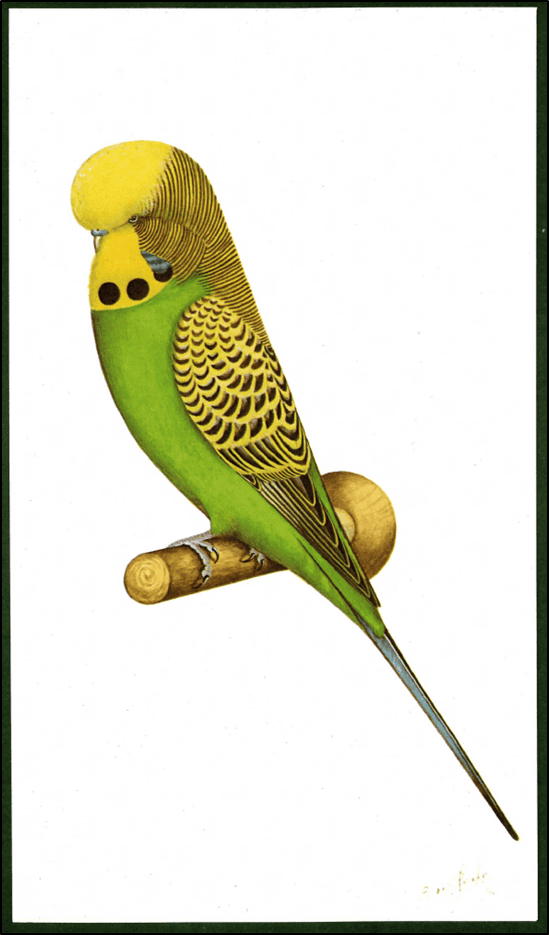
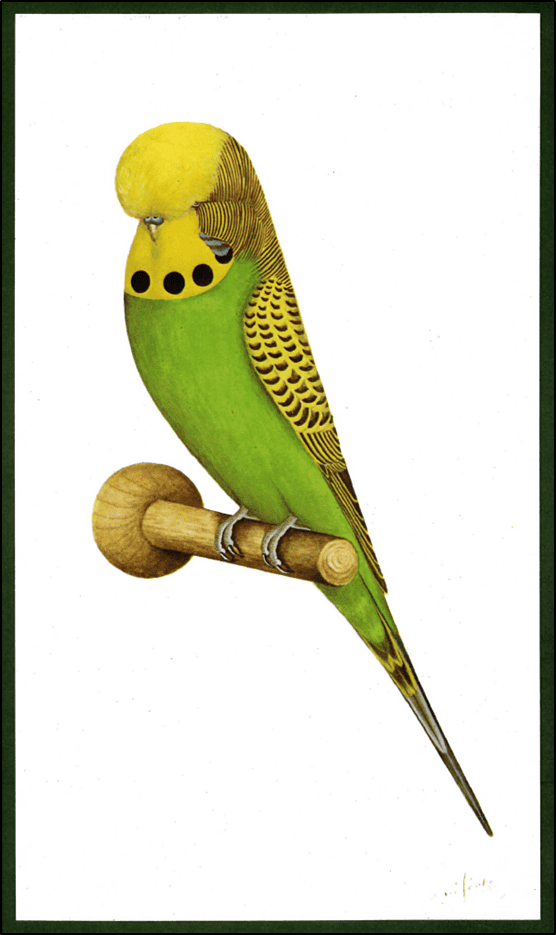
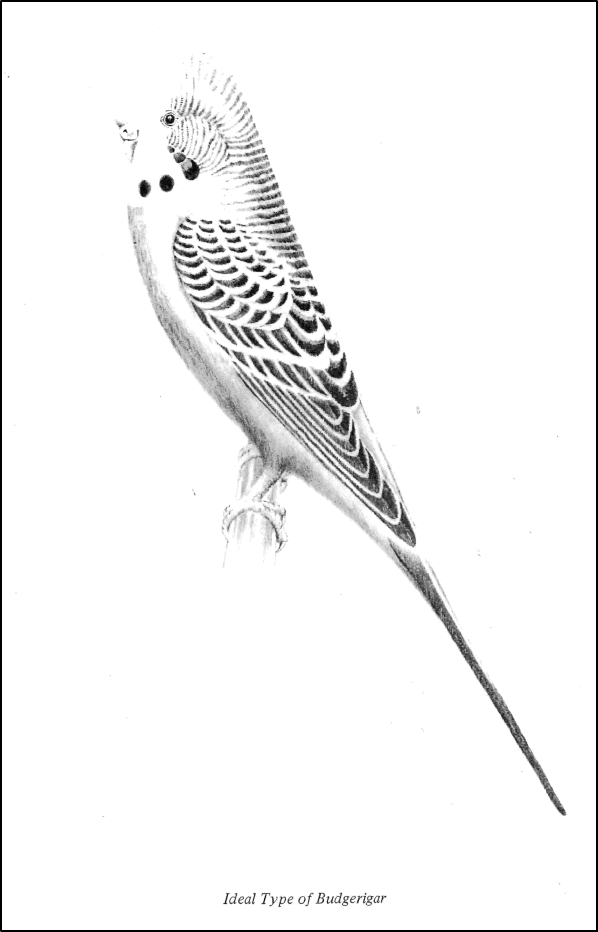
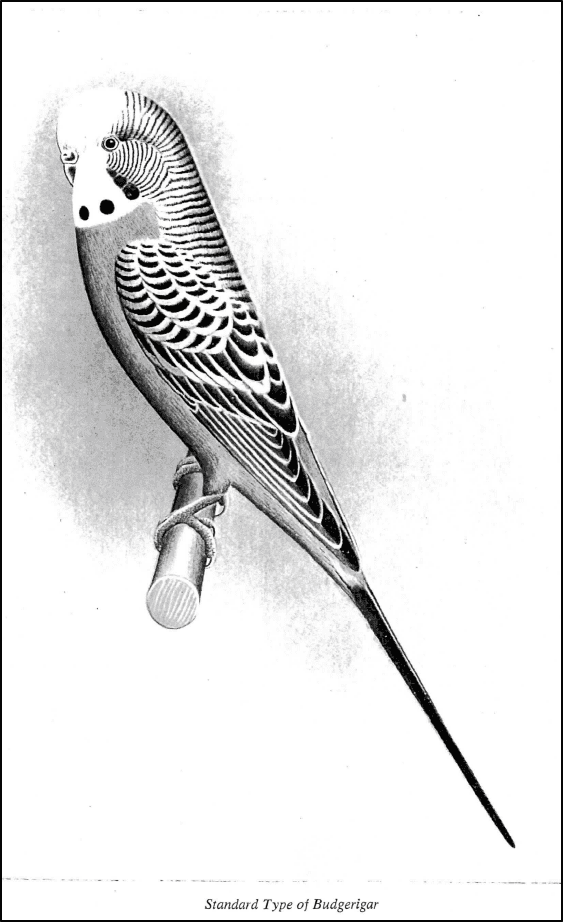
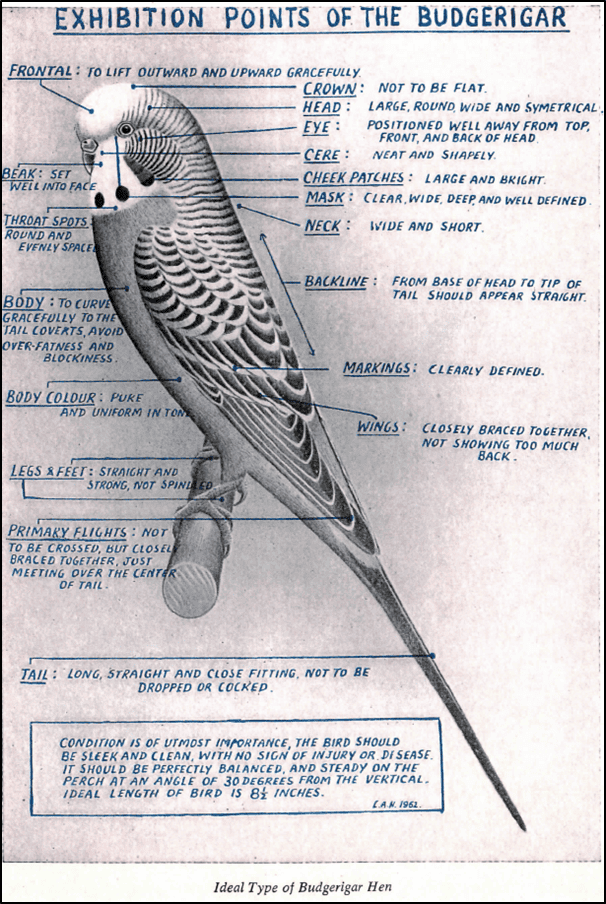
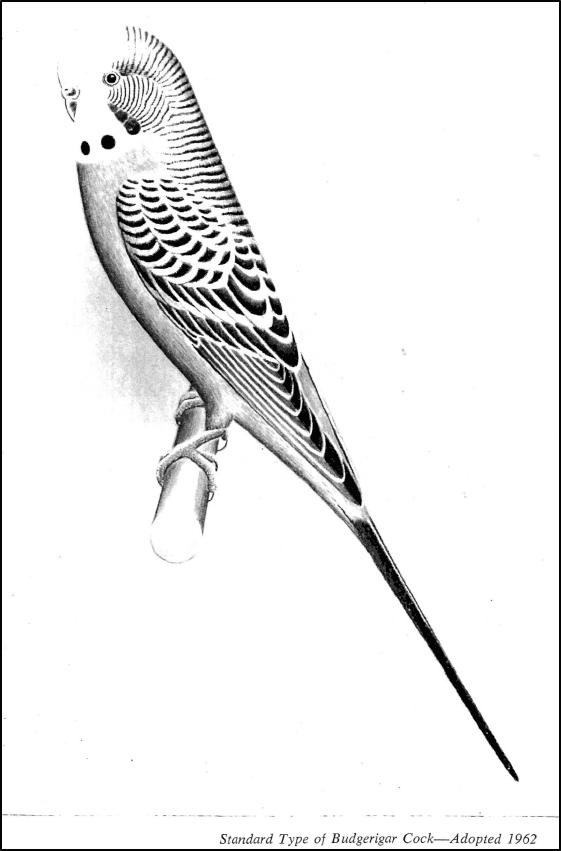
The Ideal Budgerigar
The concept of the “Ideal Budgerigar,” influenced by the United Kingdom Standard, played a critical role in shaping expectations.
The ideal bird stands at approximately 30 degrees from vertical, with:
- A strong forward rise and skull development
- A deep, well-spotted mask
- Clear, uninterrupted feather lines
- Balanced body proportions and stance
The bird must present both power and refinement — combining presence, balance, and feather quality.
“The modern exhibition budgerigar is defined by balance — not excess.”
A.R. Secombes
General Secretary & Treasurer
Budgerigar Society (UK)
A Lasting Legacy
The development of “The ANBC Standard” represents more than just a rulebook — it reflects the evolution of the hobby itself.
It is the result of collaboration, compromise, and a shared vision for excellence.
Today, it continues to guide breeders, judges, and exhibitors across Australia — ensuring the Fancy remains strong, consistent, and respected both nationally and internationally.
“The Standard is not just written — it is lived, refined, and carried forward by every generation of fanciers.”
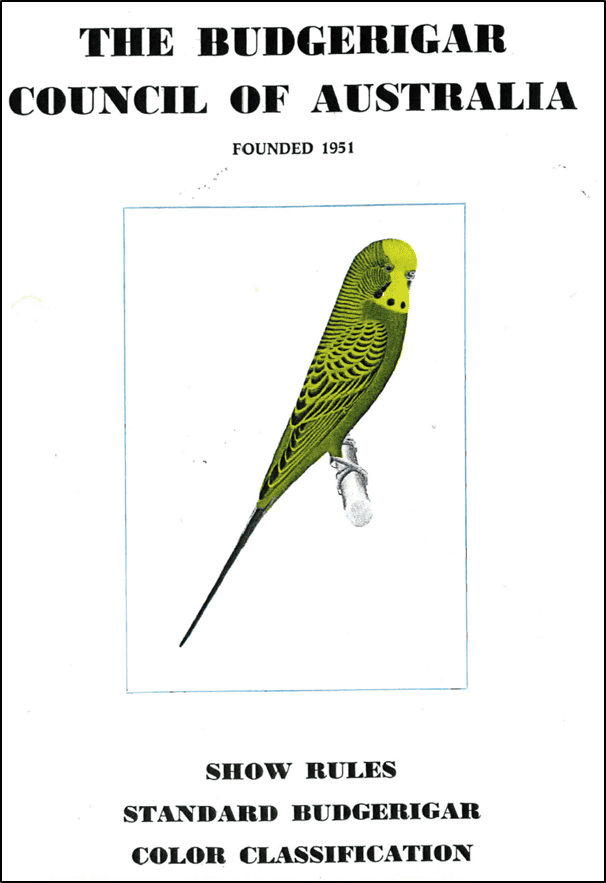
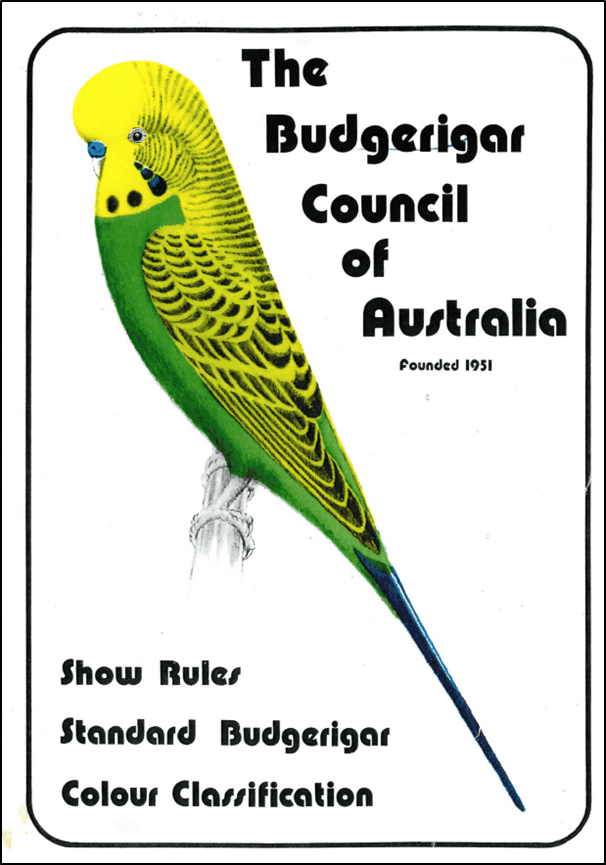
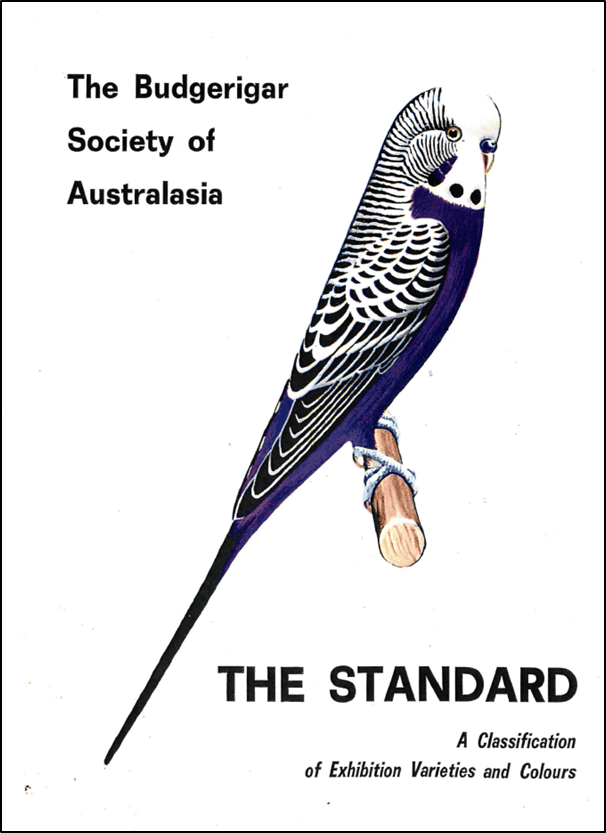
The Budgerigar Council of Australia (now BCV)
Budgerigar Society of Australasia
(now Budgerigar Council of New South Wales)
Western Australia Budgerigar Council
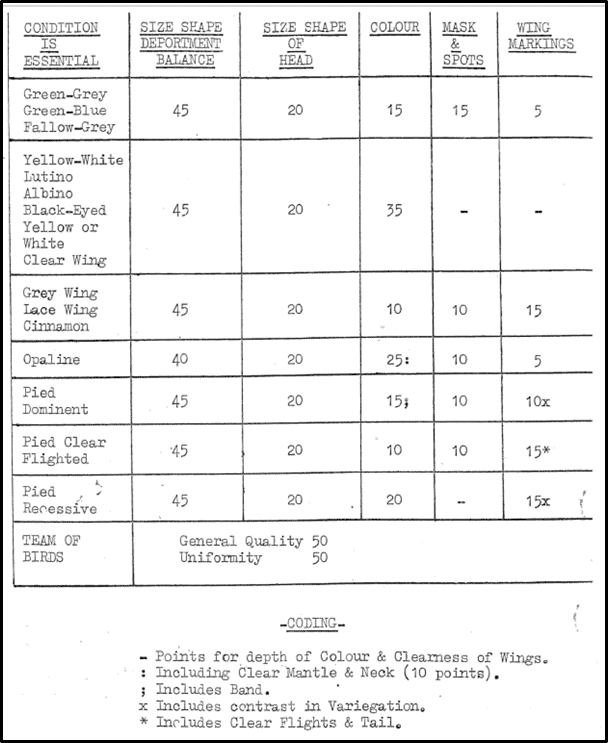
Budgerigar Society of South Australia
Transferred to:
Budgerigar Council of South Australia