Australian National Budgerigar Council


Spangle Origins
Spangles: Single Factor and Double Factor
The Spangle mutation is one of the few mutations to occur in the latter half of the twentieth century. For this reason, they became an overnight favourite with many fanciers across Australia. Interestingly, the first impression by many fanciers was totally incorrect when describing this new wing pattern. To that end, fanciers thought the colours on the wing had changed places. For this reason, some believed that an all-black wing or a perfectly clear wing was just around the corner.
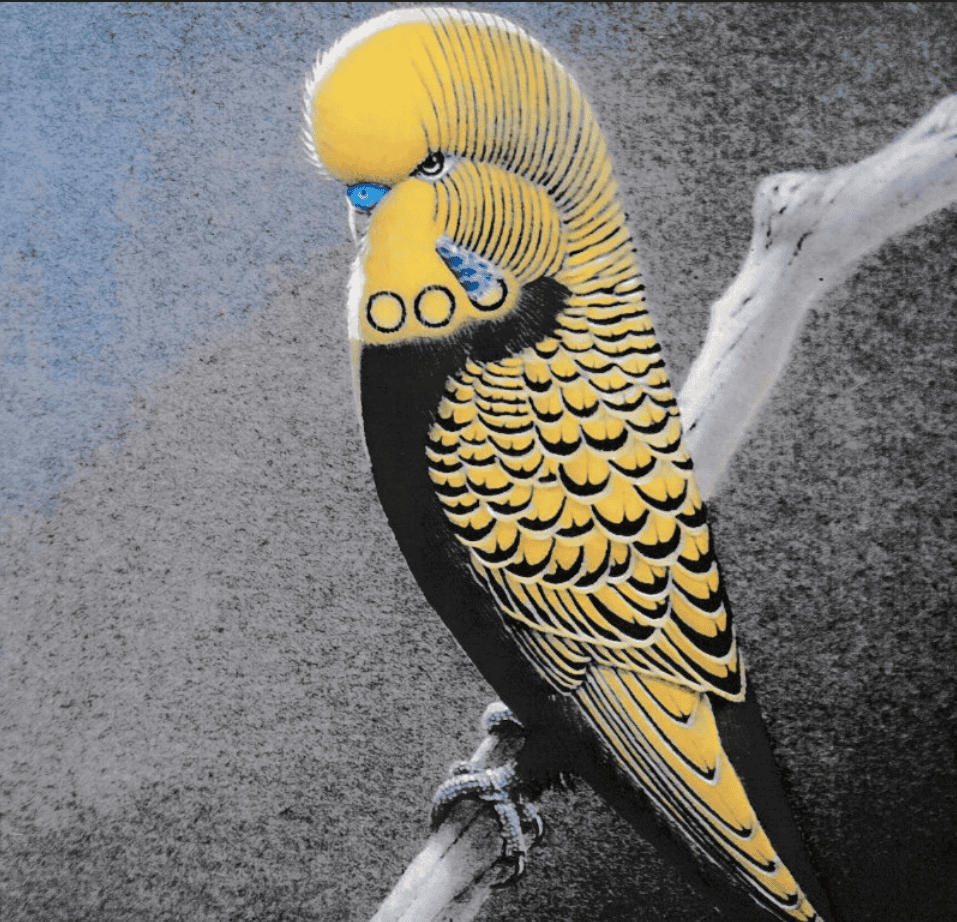
The reality was simply a reduction of the melanin (the black pigment) due to an increase of the yellow or white ground colour encroaching on the melanin sites. A simple way to describe this is to look at the wing markings of a Normal wing pattern. This can be observed as something of a half-moon shape. The Spangle wing has these half-moon shapes reduced to a thin crescent moon. The quill on a good wing pattern shows black. As a result, this creates an “anchor” design.
Spangle Double Factors have the yellow or white ground colour covering all markings and the body colour. This gives us a self-coloured bird.
Breeding Challenges and Wing Pattern
Over the years, Spangles have been bred with and introduced to many other mutations. This has often happened to the detriment of correct markings. In some places, variety features have deteriorated to the point where there is very little to almost no wing pattern. This produces a washed-out wing that approaches a Clearwing look. My own experience leads me to believe that to maintain good wing pattern, the breeder must work to a definite plan.
Expected Results from Common Pairings
Spangle Single Factor x Spangle Single Factor will produce:
- 25% Normal
- 50% Spangle (Single Factor)
- 25% Spangle Double Factor
Many of the Spangle Single Factors produced in this mating have so much black in their wing that they can be confused with Normals. Many of the Spangle Double Factors produced this way have body colour suffusion (green or blue) in what should be correct yellow or white body colour. Certainly, a percentage of correctly marked and coloured birds should be produced.
In my own experience, using a Normal gave me more correct wing pattern in the youngsters than Spangle-to-Spangle pairings. Although the reverse would have been my original expectation, a Normal Grey or Normal Grey Green parent used in the mating always helped to maintain the black markings as black and sharp as we demand.
Spangle Single Factor x Normal will produce:
- 50% Normal
- 50% Spangle Single Factor
With this pairing, a good number of the wing patterns should be correct to the Standard.
Spangle Double Factor x Spangle Single Factor will produce:
- 50% Spangle Single Factor
- 50% Spangle Double Factor
Once again, I found similar results to Spangle Single Factor x Spangle Single Factor—suffusion of green or blue in the Spangle Double Factors, and some Spangle Single Factors showing so much black they can appear Normal. No Normals can be produced from a mating of Spangle Single Factor to Spangle Double Factor.
Recommendations
All of these matings can and do produce some excellent examples of varietal features. However, a quick look on the show bench soon reveals they are not easily bred with the required markings or colour.
My recommendation is to mate a Spangle Single Factor to a Normal, ensuring that one (and only one) of the parents is either Normal Grey or Normal Grey Green.
To produce nice yellow or white double factors without suffusion, I found that using Spangle Cinnamonwings gave me good yellow or white Spangle Double Factors.
Maintaining Colour vs Maintaining Wing Pattern
Once a good coloured yellow or white Spangle Double Factor has been bred, it is easier to maintain that colour by pairing good-coloured birds together. For example, Spangle Double Factor to Spangle Double Factor. Maintaining good colour is a much easier task than trying to maintain correct wing pattern on a Spangle Single Factor.
Common Faults in Spangle Single Factors
Faults include the appearance of “Pied” markings on the body. In the case of a definite band, it would be classified as a Pied; however, the appearance of a single head spot would not be classed as Pied. Spangle Single Factors are the only variety where this is a penalty rather than being classed as non-standard.
Certainly, the breeding is a challenge—but a challenge not beyond good planning, keeping of good records, and careful observation.
Ron Hunt