Australian National Budgerigar Council


Tail Feather Cutting
Tail Feather Cutting in Budgerigars: Myth, Mechanism and Best Practice
Dr Hamish Baron – The Unusual Pet Vets
Question: Some fanciers are promoting the practice of cutting tail feathers and then leaving them for a few weeks before pulling them, supposedly to encourage new growth so the bird is show-ready. Is there any logical basis for this practice?
———————————————————————————————————————-
Thank you for your question, which touches on a long-standing practice in aviculture that continues to circulate, particularly among exhibitors preparing birds for show. The idea of cutting tail feathers halfway along their length and later pulling them to encourage fresh growth is one that sounds plausible on the surface, but when examined through the lens of avian biology, it does not hold up.
At the core of this discussion is a simple but important point: a mature feather is not a living structure. By the time a feather is fully formed, the tissue within it has lost its blood supply and nerve connection. What remains is keratin, the same structural protein that makes up nails and hair. Cutting a tail feather midway along its shaft is therefore equivalent to trimming a fingernail. It alters the shape of the structure but has no capacity to influence the follicle beneath the skin or the timing of replacement.
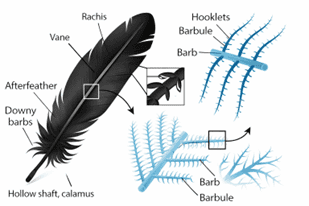
To understand why this is the case, it is helpful to review the structure of a feather. Each feather consists of a calamus, or quill, which anchors it into the follicle, and a rachis, which forms the central shaft. Extending from the rachis are barbs and barbules, which interlock to form the vane. During development, the interior of the calamus contains a vascular pulp supplying nutrients to the growing feather. Once growth is complete, this blood supply recedes, leaving the feather as an inert structure.
The feather growth cycle itself is tightly regulated and follows a predictable pattern. New feathers emerge from follicles in the skin during the growth phase, known as anagen. At this stage they are often referred to as blood feathers due to their active blood supply and sensitivity. As the feather matures, the blood supply withdraws and the feather becomes fully keratinised. It then enters a resting phase, during which it remains functional but biologically inactive. Eventually, as part of the moult cycle, the feather is shed and replaced by a new one growing from the same follicle.
Below is a simplified illustration of feather anatomy:
This cycle is governed by internal physiological signals, including hormonal influences, seasonal changes, nutrition and overall health. It is not something that can be accelerated simply by altering the structure of the existing feather.
So why does the practice of cutting and later pulling feathers sometimes appear to work? The answer likely lies in mechanical rather than biological effects. A feather that has been partially cut may be structurally weakened and more prone to breakage or dislodgement during normal activity or handling. If the feather was already nearing the end of its natural cycle, it may be shed soon after, giving the impression that the intervention triggered the process. In reality, the timing is coincidental.
There are also risks associated with this approach. If a feather is mistakenly cut while still in the blood feather stage, it can result in significant bleeding and pain. Premature pulling of feathers that are not ready to be shed can damage the follicle, potentially leading to delayed or abnormal regrowth. Repeated handling and manipulation can also contribute to stress, which in itself can negatively affect feather quality and moult timing.
For breeders and exhibitors aiming to have birds in peak condition, the most reliable strategy is to work with the natural moult cycle rather than attempting to override it. Optimal nutrition, particularly adequate protein and essential amino acids, plays a critical role in feather development. Ensuring birds are in good health, minimising stress, and planning breeding and show schedules around expected moult periods will produce far more consistent and high-quality results.
In summary, cutting a tail feather does not influence its biological lifespan or stimulate regrowth. The feather is already non-living, and the follicle beneath it operates according to its own internal schedule. While the practice may persist due to anecdotal reports, there is no physiological basis to support its effectiveness, and it carries avoidable risks. A focus on husbandry, nutrition and timing remains the most effective and welfare-conscious approach to achieving show-ready birds.