Australian National Budgerigar Council


Genetic Anomalies in the Nest Box
Vet Corner – Genetic Anomalies in the Nest Box
By Dr Hamish Baron
Understanding the genetics behind half-sider and feather duster budgerigars.
After a half-sider bird was benched in the Champion section of the recent Nationals, and following a very interesting and lively discussion about the genetics of a range of budgerigar conditions on the Budgerigar Society Facebook page, this article takes a closer look at two genetic anomalies in the nest box.
Unexpected Discoveries in the Nest Box
Many of us will say it is that time of the year again: babies are hatching, parents are feeding and the chicks are starting to feather up. It is my favourite time of year as a budgie fancier – it is the time when all of our hard work is hopefully rewarded with beautiful young birds on the perch and parents who are raring to go again. To that end, it is also the time of year when we notice interesting-looking birds in our nest boxes. This article will touch on two of those genetic anomalies – the “feather duster” budgerigar and the half-sider budgerigar.
Understanding the Half-Sider Budgerigar
In order to understand the half-sider anomaly, I will need to use some scientific jargon, so please forgive me and feel free to contact me if there is anything that is unclear!
What Is a Tetragametic Chimera?
A half-sider is a tetragametic chimera:
- Tetra: Meaning four.
- Gametic: Meaning gametes (sperm and ova).
- Chimera: Meaning a single organism composed of two different populations of genetically distinct cells that came from two different zygotes (early stages of fertilised cells).
In order for a tetragametic chimera to form, two fertilised eggs must fuse together.
Put simply, half-sider budgerigars are formed when two fertile yolks come together to create one egg.
It happens purely by accident and is not an inherited mutation. It occurs when the female has released two yolks from her ovary at the same time (not an uncommon occurrence), and they fuse after each is separately fertilised by different sperm.
Why Do Half-Sider Budgerigars Have Different Colours?
Because the half-sider is essentially the combination of two baby budgerigars fused together, it has two genetically distinct populations of cells.
In a visual half-sider, pigment on one side or part of the body is controlled by one set of chromosomes, while pigment on the other side or part of the body is controlled by the other set of chromosomes from the other zygote. This is why half-siders are generally two colours.
If the zygotes had not fused, you would have had two healthy, perfectly normal budgerigars – one blue and one green, for example.
Half-siders have the potential to display all combinations of colours. It all depends on the parents and their genetics!
Can Half-Sider Budgerigars Be Bred?
It is for this reason that the half-sider budgerigar is not a true inherited mutation. By breeding two half-sider budgerigars together, you will only create another half-sider by chance, rather than through predictable inheritance of the half-sider characteristic.
When it comes to breeding a half-sider with another budgerigar, the genetic characteristics that may be passed on depend on which population of genetically distinct cells contributed to the formation of the reproductive tract.
A very important point to consider is that if the sex of one zygote was female and the sex of the other was male when the half-sider was formed, the resulting budgerigar may be infertile due to abnormalities in the development of the reproductive tract.
Half-siders displaying characteristics of both sexes may also have two colours to their cere – one side blue and the other side brown.
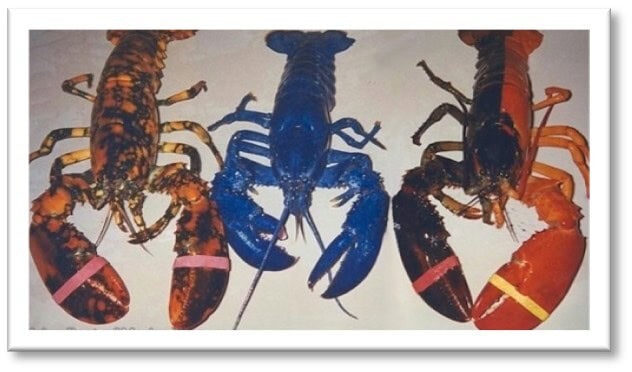
Unusual colour expressions in lobsters, including a striking example of bilateral colour division. |
The Feather Duster Budgerigar
The feather duster genetic anomaly is a little less well understood. It is a term which describes a severe disturbance in feather growth.
Also known as chrysanthemum disease, it is characterised by the continued growth of flight, tail and contour feathers.
Affected birds are unable to fly and, interestingly, are unable to make characteristic budgerigar sounds.
It is believed to be caused by an autosomal recessive gene and was first reported in England in 1966, but is well known in Australia and has also been reported in the United States.
The Genetics of Feather Duster Budgerigars
Because it is believed to be caused by an autosomal recessive gene, both parents must carry a single copy of this recessive gene in their genome and pass that copy on to the chick.
The chick, which receives two copies of the recessive gene, will therefore express the feather duster traits.
Under this proposed recessive inheritance model, the pairing of two carrier parents would produce the following probabilities for each chick:
| Genetic Outcome | Description | Probability |
|---|---|---|
| Unaffected, non-carrier | Does not carry the recessive gene | 25% |
| Unaffected carrier | Carries one copy of the recessive gene | 50% |
| Affected feather duster | Inherits two copies of the recessive gene | 25% |
These probabilities apply independently to each chick under the proposed autosomal recessive inheritance model. They do not guarantee the proportions of affected or unaffected chicks within an individual nest.
Considerations for Budgerigar Breeders
This means that two carrier parents are expected to have a one-in-four chance of producing a chick that is a feather duster under the proposed inheritance model.
For this reason, it is often recommended that pairs that produce a feather duster are not paired again in the future.
Half-Siders and Feather Dusters – A Genetic Comparison
Although both conditions can result in unusual-looking budgerigars in the nest box, their underlying mechanisms are quite different.
| Characteristic | Half-Sider | Feather Duster |
|---|---|---|
| Underlying mechanism | Chimerism, as described in this article | Suspected autosomal recessive inheritance |
| Visual characteristics | Distinct colour regions within the same bird | Abnormal, continued feather growth |
| Predictable inheritance | Not inherited as a conventional colour mutation | Recessive inheritance is suspected |
| Potential implications | Possible reproductive abnormalities | Significant impairment of flight and normal function |
Editorial comparison based on the conditions and proposed genetic mechanisms discussed in this article.
Dr Hamish Baron
Published in Vet Corner – December 2026 edition of the ANBC Gazette.
Vet Corner is an educational feature of the Australian National Budgerigar Council, exploring avian health, genetics, breeding, nutrition and husbandry to support budgerigar breeders and enthusiasts.
This article is provided for educational purposes. Birds exhibiting abnormal feather growth, developmental abnormalities or other health concerns should be assessed by a qualified avian veterinarian. The genetic mechanisms discussed reflect the author’s explanations, and further investigation may be required to establish the cause of individual cases.
Learn more about the different budgerigar varieties recognised in Australia.