Australian National Budgerigar Council


Black Eyed Yellows
By Ron Hunt
Former ANBC Historian
The Black Eyed Yellow mutation has a very special place in Budgerigar history. The first mutation to occur in captivity, and one of the reasons why fanciers all over the world became fascinated, resulting in numbers of budgerigars being bred just to see which colours would appear in the nest. Reasons other than these facts alone have tempted breeders to breed this lovely mutation: special breeders’ trophies and awards, a class in the National Championships, all add up to make these beautiful birds all worthwhile, trying to perfect.
My own personal reason is one of admiration, and my flights are in a position to allow the late afternoon sun to play upon their plumage when they arrive at the feeding station during the afternoon feed. This sight alone convinces me every day I need Black Eyed Yellows as part of my aviary. The birds during this time look like living gold. I have personally kept this variety for over twenty years, and despite the many ups and downs (more downs than ups), I could never imagine giving them up. Six times in the State Team and six winners of the B.S.A breeder’s trophy at the annual event have certainly given me incentive enough. However, these brightly coloured birds are the first I look for when entering my aviary each day, and I guess they will always have a spot in my heart and home. Breeding them all the time, I have not found them to have any vices or problems in the breeding cabinet, unlike any other type of budgerigar. Many people fall by the wayside when faced with the many disappointments when they turn out poor quality results. I might add, from my show point of view, as many as seventy-five percent could be classified as pet shop style, and of the remainder, only half are considered good enough to breed from the following season. The best of these being benched in shows are still unable to take out major awards.
I look to the late fifties and early sixties and wonder at times what was happening. During these years the Black Eyed Yellows took out the awards. I believe their old rival the Lutino was one of the main reasons the Yellows were left behind. The old story is a sex-linked variety improved more readily and jumps ahead a lot quicker. Using a Lutino to say a Normal Green Hen as an outcross, one can breed in the first nest (indeed all the hens are Lutino) split Lutino Cocks thus creating the outcross blood with the first mating.
Breeding with the Recessive variety like a Yellow is not nearly so easy. A split Yellow Cock or Hen mated with a Green Cock or Hen would produce all split Yellow with not a Yellow bird in sight. These Green splits when mated together will only produce twenty-five percent with the added problem of having to decide which of the greens are split Yellows and which are not. The resulting runoff test can be quite off-putting.
I recommend therefore to re-mate our splits with another Yellow and this again is breeding or line breeding to the very variety we are trying to improve. The resulting number of Yellows (fifty percent) and all the Greens produced are split Yellows giving the beginner a great more encouragement, but as one progresses to this method of mating, split provides the better show birds. One word of warning, to the newcomer, is to remember the Cinnamonwing when outcrossing. Our Yellows today are indeed cinnamon in colour and have pink eyes for their first seven days as have all Cinnamonwings, but for a reason best explained by more educated people than me, the cinnamon markings do not appear as such when the bird is fully moulted. Without this Cinnamonwing blood our Yellows appear with a much duller colour, losing that brightness and generally has more Green suffusion than can be tolerated by a Yellow supporter. One should not confuse fanciers with the genuine Cinnamonwing markings, the bird with the Cinnamonwing markings have proven to be compatible when mated together in my set up – I would sum up by saying the Cinnamonwing is the best outcross I have used and have always bred Cinnamonwings for this purpose.
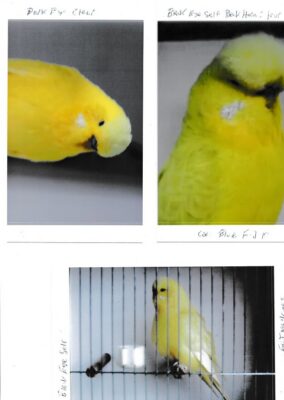
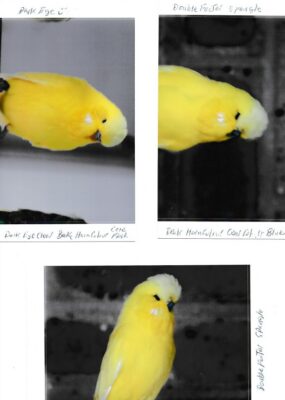
During recent years other mutations have appeared on the scene to challenge the Black Eyed Yellow and our standards have had to be reworded to define the differences and to ensure judges are able to detect usurper and wrong class it. The most recent of these is the Spangle Double Factor, a very pretty bird, but not a true Black Eyed Self. This bird can be detected even when completely yellow and not showing the green collar when looking at the wings, neck, back and head and cheeks. These areas should still display the melanin sites as sort of ghost markings in the best of Yellows and the Spangle wings should be completely clear or very faint Spangles. The standard has now been written in such a way as to allow for this fact and not penalise the bird. It should be pointed out though, the lighter the better is the order of the day and a bird with very heavy markings would still carry heavy penalties in this area.
Our other challenge came from the Dark Eyed Clear, a pied combination breeders using Danish and Continental Pied’s discovered when mating to Dominant Continental Pied split for Danish together, where an all-yellow bird was produced. This bird gives itself away with no iris on his eye and his cere being like the fleshy colour of the Lutino. This gives rise to the name Black Eyed Lutino I have heard used. The newcomer armed with these facts should never be fooled into buying birds that are of no use in producing Yellows. The reason they are of no use is a simple matter of knowing how the Yellow comes about. Our Black Eyed Yellow is a result of having no blue pigment in its feathers.
The green budgerigar has actually no green pigment in its feathers, the green colour appears as a green because the light passing through the blue and yellow pigments mixes and it appears as green. However, the other self-coloured yellow is a result of a yellow wash masking all colours including the melanin sites in the wing etc. I do hope this explanation gives potential breeders a better insight into the make-up of the Black Eyed Yellow.
Bad show faults outside of the obvious type are, too light in colour, too much green suffusion and the wings are lighter shade of yellow to the body colour. All of these are easily rectified by careful selection of mates that do not share the same faults and can be done within the variety itself.
I must point out though, the challenge to improve the type is a much harder line to pursue and the breeder must proceed with caution or lose the variety characteristics and finish with a bird looking nothing like a self-coloured. The use of Cinnamonwing is an advantage but they must be good quality to be of any use.
Editors Note – the above is a fantastic article, however it would be remiss not to flag that it makes a statement that the Black Eyed Yellow has no blue pigment, and then states that green is the result of mixing blue and yellow pigments. At the time this historical original article was written, the mechanism for blue and green would not have been understood. It is now known that there is no blue pigment. The Black Eyed Self mutation significantly decreases the amount of melanin in the feather so the feather fails to preferentially absorb light from the red end of the light spectrum. That means that reflected light remains white, rather than being enriched for the blue end of the light spectrum. So incident white light being reflected as white light upon passing through the yellow pigment in the feather of the Black Eyed Yellow appears yellow. In the absence of the yellow pigment the Black Eyed White appears white. When we relax selection for colour, allowing some melanin into the feather of our flock of Black Eyed Selfs, we see pale green body suffusion and pale blue body suffusion in the Black Eyed Yellow and the Black Eyed White, respectively. Body colour suffusion is a serious fault now prevalent in exhibition Black Eyed Selfs, many of which are approaching what the Standard describes as Dilutes. Mention of Olive Black Eyed Yellows being mustard in colour is interesting, since that is the expression for Black Eyed Yellows with Grey content, subject to having a grey muted cheek patch, even those with little or no Green body suffusion. Grey remains allowable in the ANBC Standard for Black Eyed Selfs because it is a requirement for breeding Black Eyed Whites where eliminating or minimising blue suffusion is a challenge. The key for breeding the Black Eyed Yellow is to remember buttercup yellow, irrespective of the grey factor, with 40% of the judge’s assessment assigned for yellow. Green body suffusion is supposed to be severely penalised on the show bench, consistent with that 40% to be assessed for the quality of colour.