Australian National Budgerigar Council


Dale Vanclieaf 2026
Fancier in Focus – Overseas
Dale Vanclieaf – A Stud Built on Directional Feather
Sixteen years of selective breeding, three consecutive Canadian National victories and a contribution to the Fancy that continues beyond the breeding room.
By Emma Sampson
Avian Behaviourist, Aviculturist and Founder of Rock the Flock LLC, Virginia, USA
Few results demonstrate the depth of an exhibition budgerigar stud quite like having three birds occupy the leading positions at a major show. Canadian fancier Dale Vanclieaf achieved precisely that at the Canadian National Cage Bird Show in 2023, when his birds were awarded first, second and third Best Budgerigar under Belgian judge Maarten Heylen. He repeated the achievement in 2024 under Julie Willis of the United States and again in 2025 under American judge John Joyner, completing three consecutive years in which the top three overall budgerigar awards went to birds from his stud.
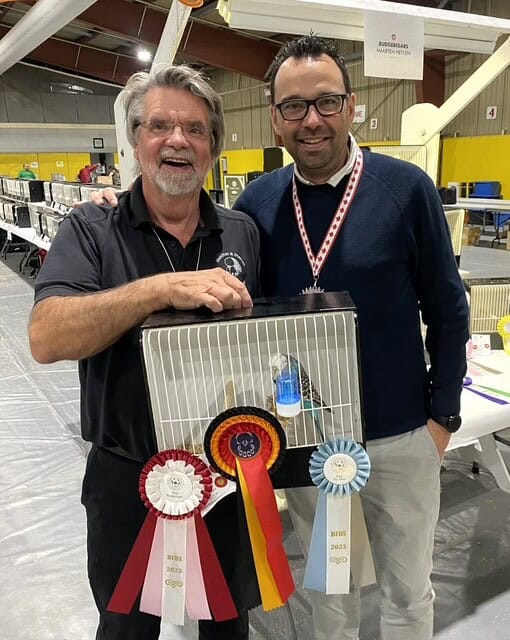
A 2023 exhibition photograph featuring a budgerigar, award rosettes and exhibitors. The photograph documents the show environment; individual award details are not attributed to this image. |
It is an impressive record by any measure, although the results are perhaps more interesting when considered alongside the sixteen years of breeding and selection that preceded them. Dale had developed a particular interest in directional feather, pursuing the combination of feather length, density and growth direction that contributes so much to the appearance of a quality exhibition budgerigar. His appreciation of this characteristic, together with a broader commitment to head quality, spotting, deportment, balance and overall size, became an important part of the stud’s identity.
With Dale now retired from active breeding, his birds have moved from Canada to Rock the Flock in Virginia, where his established bloodlines are being preserved and developed further. His own involvement in the Fancy, however, is far from finished, with judging commitments continuing into 2027. It is a fitting next chapter for someone whose contribution has extended well beyond breeding successful birds.
An Interest in Directional Feather
For experienced exhibition breeders, the appeal of a well-feathered bird is not simply the amount of feather present, but how that feather grows, falls and contributes to the overall shape of the head. The Australian Standard of Perfection places considerable importance on the direction and sweep of the head feather, particularly its progression from the cere, across the frontal and over the crown towards the backskull.
This was an aspect of exhibition breeding that particularly interested Dale. Directional feather length and density were central to his selection priorities, although he was equally conscious of how those qualities related to the complete bird. A strong frontal must complement the head, while width, depth of mask, spot quality, body structure and deportment all contribute to the impression presented on the show bench.
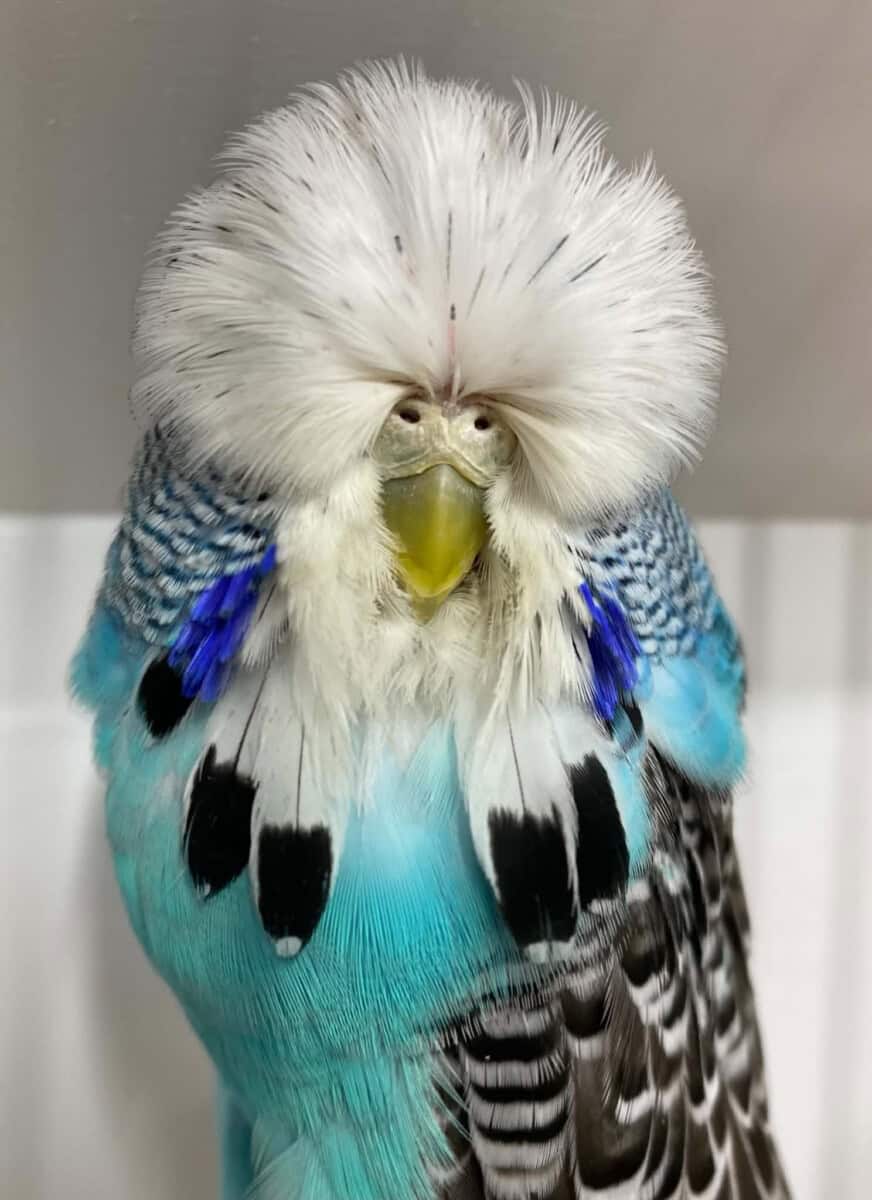
An exhibition budgerigar with a pronounced frontal, sweeping head feather, a broad mask and distinct throat spots – qualities central to Dale Vanclieaf’s selective breeding priorities. |
The challenge for any breeder is to establish those characteristics consistently rather than producing an occasional outstanding individual. The best bird in a stud may be a pleasure to exhibit, but the real value of a breeding family is demonstrated in the quality it can produce over successive generations. That requires an eye for birds which not only possess desirable characteristics themselves, but also have the breeding background to contribute them to their offspring.
Dale’s interest in directional feather gave his selection a recognisable emphasis without losing sight of the overall exhibition ideal. The birds he developed became particularly notable for their substantial head feather, size and presence, while retaining the balance and deportment he considered important. His later exhibition results suggest that this combination of characteristics was not confined to one or two exceptional birds, but had become established across a successful breeding family.
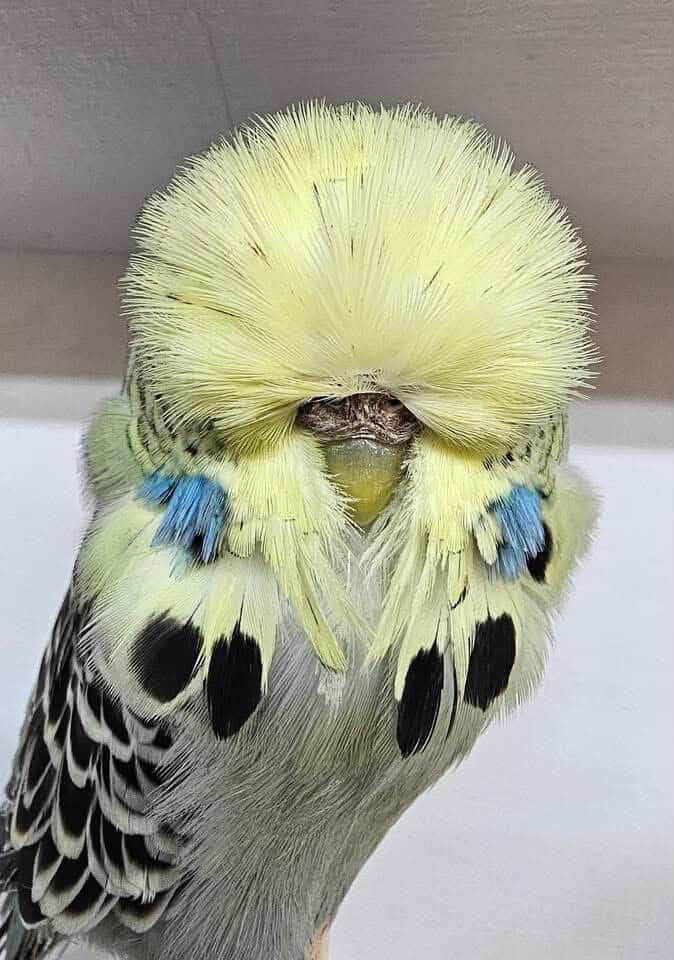
A yellowface grey exhibition budgerigar illustrating substantial head feather and frontal development. |
For those who have spent years working towards a particular feature, the significance of such consistency will be readily appreciated. Progress is often gradual, and improvements in a stud may take several generations before they become reliably established. Dale’s achievements are best understood in that context, as the product of sustained selection rather than the discovery of a single remarkable breeding pair.
Sixteen Years of Progress on the Show Bench
Dale’s success at the Canadian National was established well before his remarkable run from 2023 to 2025. The published show records document a steady progression through the exhibition ranks, including notable Novice results and a series of overall National placings during the years leading up to his eventual victories.
Among those early successes, one result remains especially meaningful to Dale: his first Best in Show, awarded at the 2015 Canadian Avicultural Society Show by Ladislav Groda of the Czech Republic. Dale still remembers the occasion with particular affection, describing that first Best in Show as a very special moment in his exhibition career. His progress continued at the 2016 Canadian National, where a bird from his stud was awarded Second Best Budgerigar under Carl Slavin, alongside further leading Novice and variety awards. Third Best Budgerigar followed in 2018, and in 2019 he returned to second place overall, with additional awards for Spangles, Clearbodies and Dark Factor varieties.
These earlier results are particularly relevant to the history of the stud because they demonstrate the level of quality Dale had achieved before introducing additional European bloodlines. He was already producing birds capable of competing successfully at National level, having spent years developing his own approach to selection.
During 2019 and 2020, Dale introduced birds from the well-known Swiss stud of Daniel Lütolf, identified by the stud number DL125. The introductions provided further breeding material with which to pursue the characteristics he valued, particularly his interest in feather direction and density. Rather than representing the beginning of his success, the Swiss birds became part of an established breeding programme that Dale continued to develop according to his own priorities.
The results of that continued work were evident at the 2023 Canadian National, where Dale’s birds not only secured the first three overall positions but also took Best Young Budgerigar, Best Opp Sex and the first four Champion Budgerigar placings. His stud was also successful in several variety awards, including Rare, Yellowface, Recessive Pied, Spangle and Sky Blue.
At the 2024 National, under Julie Willis, Dale again secured the first three Best Budgerigar positions, together with leading awards for Yellowface, Spangle and Sky Blue. The following year, with John Joyner judging the budgerigar division, he completed the third consecutive overall sweep and added Best Young Budgerigar and the first four Champion placings to his record.
That level of success under three different judges is especially noteworthy. While individual judges may differ in their appreciation of particular qualities, Dale’s birds consistently achieved the highest overall positions, demonstrating the depth of quality within the stud and the effectiveness of his breeding selections.
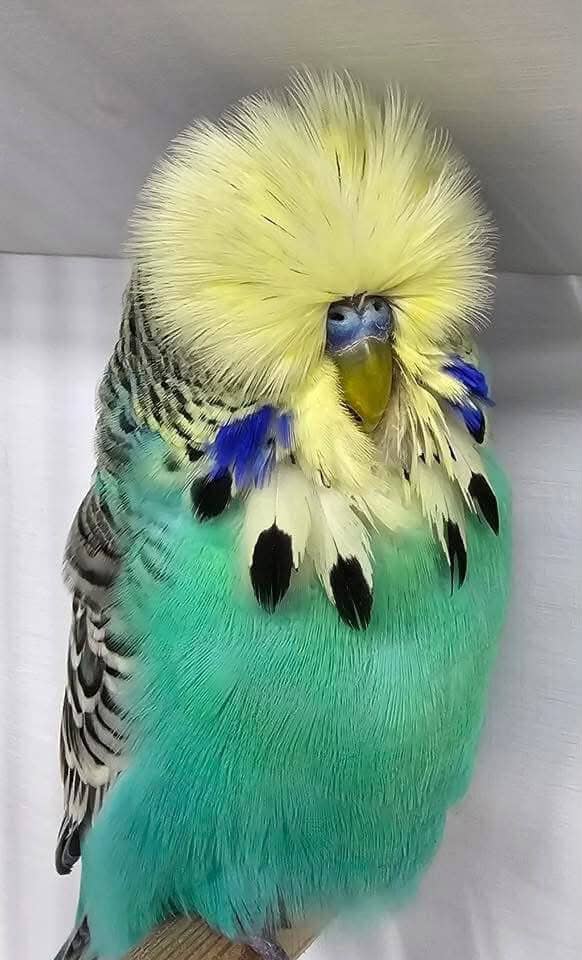
A yellowface blue-series exhibition budgerigar photographed at a three-quarter angle, highlighting head feather, depth of mask and show-bird presence. |
His achievements were not restricted to the Canadian National. Dale was also a successful exhibitor at specialist and regional events, with the World Budgerigar Organisation’s rosette records documenting Best in Show recognition at Hamilton and District Budgerigar Society events in 2024 and 2025.
Taken together, the results establish a strong record of competitive achievement over a considerable period. More importantly, they tell the story of a breeder who continued refining his birds long after he had begun winning major awards, maintaining an interest in the details of feather, type and overall quality that had guided his work from the beginning.
Continuing His Contribution Through Judging
Although Dale has retired from active breeding, he remains involved in the exhibition community through judging and international representation. The World Budgerigar Organisation lists him among Canada’s representatives through the Budgerigar and Foreign Bird Society, reflecting his continuing connection with the wider Fancy.
In November 2026, Dale confirmed that he had recently returned from judging the Canadian Avicultural Society Show and that he is scheduled to judge the 68th Annual Canadian National Bird Show in 2027. It is particularly pleasing to see his experience continuing to benefit other breeders, especially after so many years spent developing and exhibiting his own birds.
There is a natural connection between the work of a breeder and that of a judge, although the responsibilities are quite different. Breeding requires long-term decisions about selection, compatibility and the qualities likely to be passed to future generations, whereas judging involves assessing the birds presented on the day against the exhibition standard, taking account of their overall quality and condition.
Having spent sixteen years developing a successful exhibition stud, Dale brings practical breeding experience to that responsibility. His particular interest in feather, together with his experience of exhibiting under judges from different countries, provides a valuable perspective when considering the many characteristics that contribute to the complete exhibition budgerigar.
For the Fancy, the continued participation of experienced breeders is important. Much of the knowledge associated with successful studs is acquired through years of observation and cannot be fully conveyed through pedigrees or show results alone. Judging, mentoring and involvement with clubs provide opportunities for that experience to remain available to others, even after a breeder has decided to close the breeding room.
Dale’s forthcoming National judging appointment therefore represents something more than another engagement on the show calendar. It is a continuation of his contribution to the Canadian exhibition community, and an opportunity for the knowledge gained through his own breeding experiences to benefit another generation of fanciers.
A Canadian Stud Finds a New Home
When Dale decided to retire from active breeding in 2026, his exhibition budgerigars were entrusted to Rock the Flock LLC in Front Royal, Virginia, USA. For me, accepting an established and successful stud carried a responsibility considerably greater than that associated with acquiring individual breeding birds.
The value of Dale’s birds lies not only in their appearance or the awards achieved by earlier generations, but also in the years of selection behind them. Their breeding history, the characteristics he deliberately developed and the consistency achieved through successive generations form a foundation that deserves careful preservation.
My own background is in avian behaviour and husbandry, and I have always been particularly interested in how breeding decisions and environmental conditions influence the whole bird. When I began observing Dale’s budgerigars, one of the qualities that impressed me was their activity and willingness to use the aviary environment. Despite their substantial exhibition size and pronounced feather, I watched birds flying, climbing, interacting with their flock and exploring their surroundings.
For me, those observations were especially encouraging because they provided an opportunity to consider exhibition quality alongside the physical abilities and natural behaviours that remain important throughout a budgerigar’s life. A bird may be judged for its appearance and deportment on the show bench, but its daily existence also involves movement, social interaction, feeding, breeding and maintaining physical condition.
These considerations are not intended to challenge the importance of exhibition standards or diminish the achievements of breeders who have worked for generations to develop the modern exhibition budgerigar. Rather, they are part of a broader interest in how we can continue producing quality birds while giving appropriate attention to their physical condition, natural abilities and everyday husbandry.
At Rock the Flock, the breeding programme is being continued with particular emphasis on preserving Dale’s established bloodlines and the characteristics he selected for, including directional feather, head quality, size and deportment. Alongside this, the birds are maintained in an environment designed to provide meaningful horizontal flight opportunities, varied perching, structured foraging, appropriate lighting, sound nutrition and careful daily observation.
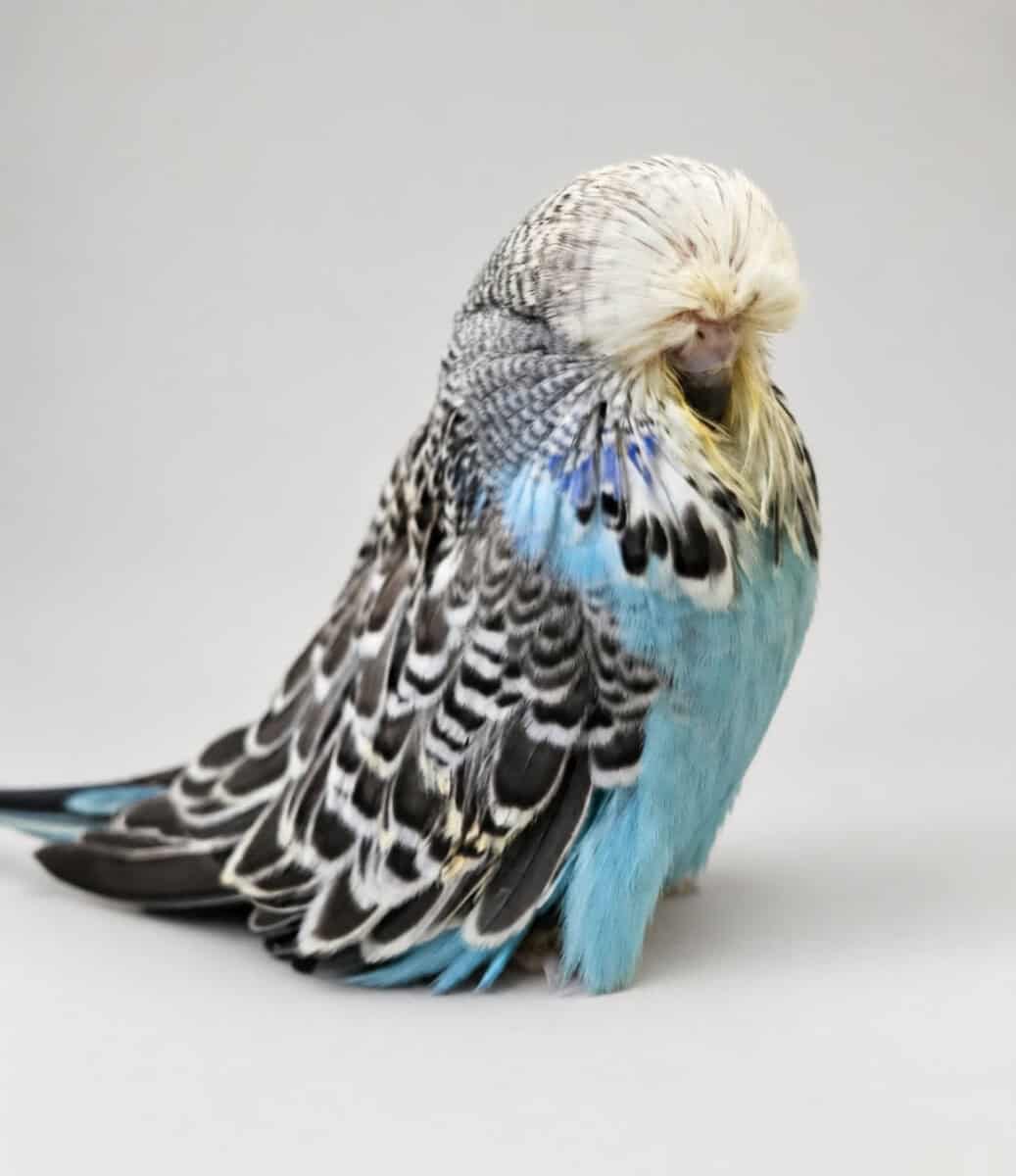
A young exhibition budgerigar hatched at Rock the Flock in 2026 from two Dale Vanclieaf-line parents, photographed while still at the nest-box stage. The breeding programme continues to prioritise directional feather. |
There is considerable value in examining how established exhibition families respond to different husbandry arrangements, although conclusions about longer-term physical performance and breeding outcomes will require continued observation. The intention is to document what we see, learn from the birds themselves and maintain a constructive connection between exhibition breeding and practical avian husbandry.
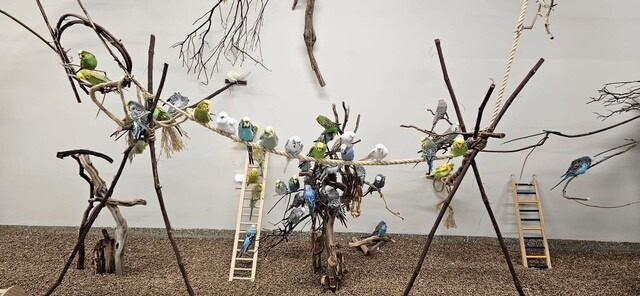
Nap time in the Rock the Flock flight habitat: Dale Vanclieaf’s exhibition budgerigars resting together among natural branches, ropes and enrichment structures. |
The programme also seeks to support the wider exhibition community through the carefully managed placement of selected birds with approved breeders. Participation in clubs, appropriate care and an understanding of the responsibility involved in maintaining established bloodlines are important considerations. The objective is not widespread distribution, but the preservation and thoughtful continuation of a stud that took many years to develop.
The Last of Dale’s Budgies
One of the most meaningful moments in the transition came with the hatching of the final chick from Dale’s Canadian breeding programme in 2026. To commemorate the occasion, Rock the Flock commissioned a mural measuring approximately three metres in length, entitled Last of Dale’s Budgies, featuring that final chick.
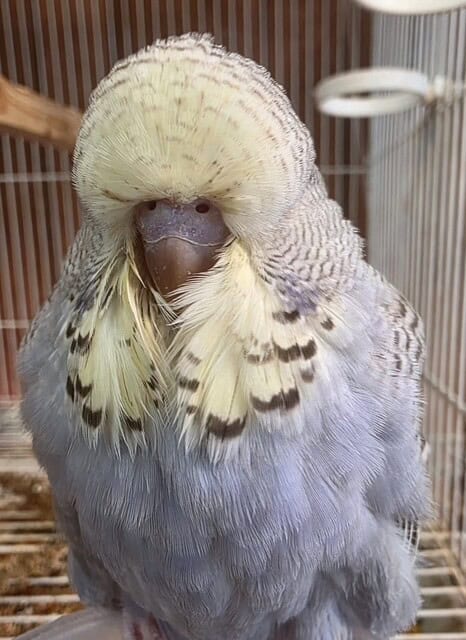
A 2026 yellowface violet grey youngster from Dale Vanclieaf’s programme, notable for its directional feather development. This bird is also represented in the commemorative artwork. |
The mural recognises the conclusion of Dale’s breeding work in Canada and acknowledges the history now carried by the birds in our care. It is also a personal reminder of the responsibility involved in continuing another breeder’s work, particularly when that work represents so many years of commitment and achievement.
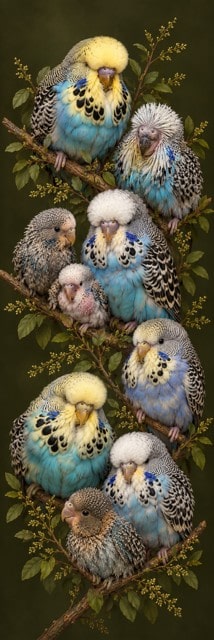
|
The Last of Dale’s Budgies – commemorative artwork created for Rock the Flock’s tribute to the conclusion of Dale Vanclieaf’s Canadian breeding programme and the continuation of his bloodlines in Virginia. Artwork; not a documentary group photograph.
For those familiar with established studs, the importance of preserving a breeding family extends beyond retaining its name or recording its pedigree. Its qualities must continue to be recognised, its breeding history respected and its future managed with an understanding of the characteristics that made it successful.
That is the responsibility we have accepted with Dale’s birds.
Looking to the Future
Dale Vanclieaf’s contribution to exhibition budgerigars is distinguished not only by the results he achieved, but also by the consistency of the breeding programme behind them. His particular interest in directional feather, developed alongside his appreciation of the complete exhibition bird, helped establish a stud capable of competing successfully over many years and eventually securing the first three positions at three consecutive Canadian Nationals.
Although the breeding room has closed, Dale’s involvement in judging ensures that his experience and knowledge remain part of the Fancy. Meanwhile, the birds he developed have begun a new chapter in Virginia, where their bloodlines will be preserved through careful selection and a continued commitment to appropriate husbandry.
I am grateful to Dale for the confidence he has placed in Rock the Flock and for the opportunity to continue working with the birds he spent sixteen years developing. Our intention is to respect the qualities he established, maintain the integrity of his breeding families and contribute to their future in a manner worthy of the work that preceded us.
For Dale, the pleasure of breeding may now have given way to the responsibilities of judging, but his contribution continues in both places: through the knowledge he shares with fellow fanciers and through the generations of budgerigars that will follow those he bred.
About the Author – Emma Sampson
Emma Sampson is an avian behaviourist, aviculturist and founder of Rock the Flock LLC in Front Royal, Virginia, USA. The Rock the Flock Budgie Edition programme focuses on the preservation of established exhibition bloodlines, responsible breeding, habitat-based husbandry, nutrition and flight.
Website: www.rocktheflockllc.com
Facebook: www.facebook.com/rocktheflock
Fancier in Focus – Overseas is an ANBC Gazette feature exploring the achievements, breeding philosophies, exhibition birds and experiences of budgerigar fanciers from around the world.
Learn more about the different varieties of exhibition budgerigars recognised in Australia.