Australian National Budgerigar Council


Larry Ann Dagg NZ 2026
Larry & Ann Dagg: Our Budgerigar Journey from Pet Birds to the Show Bench
Like many people in the budgerigar hobby, my interest in birds began long before I ever considered becoming an exhibition budgerigar breeder. Growing up, our family always seemed to have pets around us, including canaries and budgies. As children, we naturally promised our parents that we would look after them, although, as often happens, Mum usually ended up doing most of the feeding and cleaning.
How Our Budgerigar Breeding Journey Began
It was not until the 2018–2019 breeding season that budgerigars became something much more serious for Anne and me.
A mate of mine, Pete James, had started breeding budgerigars before me. During a visit to his place, he showed me his breeding setup and some newly hatched chicks. That was enough to get me interested.
Within no time I had built a 4 metre by 3 metre aviary. I was a butcher by trade rather than a builder, and the aviary certainly looked like it had been built by a butcher! It has survived though, and the main improvement since has been dividing it into two separate aviaries.
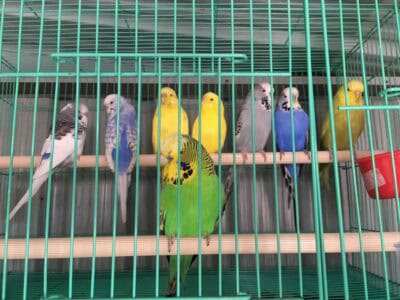
Our first budgerigars came from Quality Bird and Pet Supplies. We purchased four pairs for $39.99 per bird, and one of those pairs unexpectedly turned out to have come from a champion breeder. The pairing was a Dominant Pied Opaline Sky Blue hen to a Normal Light Green cock, and they produced the first bird I would ever take to a show — a Normal Light Green.
At the time I thought all eight of our original birds looked pretty good. I soon discovered just how much I still had to learn about exhibition budgerigars.
Catching the Budgie Bug
It probably took about a week before I had well and truly caught the “budgie bug”.
I was soon searching Trade Me for more birds when I spotted a large yellow cock that immediately caught my attention. He looked completely different from the pet shop budgies I knew, with what seemed like an enormous “Afro” around his head.
The bird belonged to Dominic Alcock in Auckland, so Anne and I made the trip to collect him along with a Normal Light Green hen. I assumed the yellow bird was a Lutino, but Dominic explained that he was actually a Spangle Double Factor and that the pairing would produce Spangles.
I did not really understand what he meant at the time. That became one of the first of countless lessons I would learn about budgerigar genetics and breeding.
Dominic also introduced us to the Auckland Metro Bird Club. Although meetings were around an hour and a quarter from home, Anne and I regularly made the trip, leaving around 5.30 pm and often not getting home until 10.30 pm.
Those meetings became an invaluable part of our education. I probably pestered Dominic and Vince Huston endlessly with questions, but that willingness of experienced breeders to share their knowledge played an enormous role in helping us progress.
Discovering Exhibition Budgerigars
Our first visit to the Auckland Christmas budgerigar show in December 2018 was another turning point.
When we arrived, we met Vince Huston for the first time. Vince immediately asked whether I was the rugby league player from Mt Albert. As it turned out, Vince was another old rugby league player, so we had something in common from the start. Anne and I have remained good friends with Vince and Lynne ever since.
We also met Geoff Callister, who took the time to sit down with us and explain the differences between pet budgerigars and birds bred specifically for exhibition. Until then, I had mostly thought about breeding different colours. Geoff opened my eyes to the challenge and satisfaction of breeding exhibition birds.
That conversation was probably the point when I decided I wanted to breed budgerigars for the show bench.
Anne and I joined the Auckland Metro Bird Club, which became our parent club. We also joined the Auckland Budgie Club, the Colour Breeders Club and, more recently, the Tauranga Bird Club to support the wider New Zealand budgerigar fancy.
Learning from Experienced Breeders
Another stroke of luck came when Dominic donated a pair of Grinter birds to a raffle — and we won them.
We had already gone home by the time the raffle was drawn, so Terry and Linda Patten kindly took the birds back to Hamilton for us.
Not long afterwards, I found some breeding cages advertised for sale in Hamilton, giving Anne and me the perfect excuse to make the trip. We collected the cages and our raffle birds, and Terry and Linda invited us to stay for lunch.
The time we spent listening to them was worth more than anything we could have bought. They openly shared their knowledge, showed us through their setup and passed on many practical breeding tips. Experiences like that taught me just how important mentorship and friendship are within the budgerigar hobby.
Building the Breeding Room
I now had birds, enthusiasm and plenty of ideas — but I needed somewhere suitable to breed them.
We had two metal garden sheds, each measuring roughly 2 metres by 2 metres. Initially, I commandeered half of one shed for my breeding room. Eventually, as my enthusiasm grew, the garden tools were evicted altogether and the two sheds were joined to create a 4 metre by 2 metre breeding room.
A friend installed power and running water, which made the room far more practical and self-contained.
I became fairly creative when it came to finding breeding cages. If I spotted an old bookshelf, kitchen cabinet or bathroom cabinet on the side of the road, there was a good chance it would come home with me and be converted into another breeding cage.
At one stage I had 22 breeding cages, and during the 2020–2021 season I bred 198 budgerigars.
That was certainly an experience — but it was far too many birds for us. Feeding costs increased dramatically and selling surplus birds from Snells Beach was difficult. Fellow breeder Sam Baker helped enormously by taking many of the birds to West Auckland and selling them for me.
I eventually reduced the setup to 12 cages. Then we renovated our bathroom and, naturally, I could not resist turning the old cabinet into another two breeding cages. Today we operate with 14 breeding cages, which is a much more manageable number.
My First Budgerigar Breeding Season
I first paired birds in January 2019 and had reasonable success, producing more than 30 youngsters from six pairs.
Eleven of those chicks came from the big yellow Spangel Double Factor cock. Paired to a Normal Light Green hen, he produced Spangle Light Greens — another practical lesson in budgerigar genetics.
Of course, breeding budgerigars also teaches you plenty of lessons the hard way.
One pair laid ten eggs and hatched eight chicks but failed to feed them. Losing those chicks was extremely distressing. Vince taught me about fostering and swapping newly hatched chicks into nests with older chicks, and during the pair’s second round I managed to save two Grey youngsters.
Unfortunately, both later escaped.
That experience taught me another valuable lesson: always close the doors behind you. We now have safety doors and self-closing doors throughout the setup.
Finding the Varieties We Love
Like many new breeders, I initially wanted to breed almost everything.
It takes time to realise that you simply cannot specialise in every budgerigar variety while doing each one justice. The upside of experimenting is that you certainly end up with plenty of colour in the aviary.
I still have a particular love for the traditional green and yellow budgerigar. There is something special about that original wild-type appearance.
Today our aviary contains a range of Normals and Opalines, along with Dominant Pieds, Recessive Pieds and a Lacewing that I particularly enjoy. Moving forward, I would like to concentrate more seriously on Dominant Pied, Recessive Pied and Lacewing budgerigars rather than trying to maintain too many different varieties.
When Budgerigars Take Over Your Life
When I first started breeding budgerigars, I had no idea how much time the hobby would eventually consume.
My other great passion is saltwater fishing. Before the budgies took over, I might have gone fishing three times a week. These days I am lucky to get out once a month.
I still maintain that I am a better fisherman than a budgerigar breeder — mainly because I have had more success in fishing tournaments than budgie shows!
Everything now needs to be planned around the birds. Holidays, whether overseas or within New Zealand, generally have to fit between March and the second week of May before the show season gets underway. Travelling during our breeding season, from around July through to January, is almost impossible. February, thankfully, becomes fishing month again.
There are certainly moments when I wonder whether breeding budgerigars takes up too much time and whether I should be doing something else.
Then breeding season arrives.
Pairing the birds, waiting for eggs and checking nest boxes for newly hatched chicks remains my favourite part of the hobby. You can plan pairings carefully, but you are never completely sure what will appear in the nest box. That anticipation keeps the excitement alive.
The Challenge of Breeding Budgerigars in New Zealand
Budgerigar breeders in New Zealand face an additional challenge.
Many breeders believe our birds have become closely related because we have been unable to introduce new bloodlines for many years. This restricted gene pool has inevitably created challenges for the development of exhibition budgerigars in New Zealand.
Even so, there are breeders throughout the country producing excellent birds despite those limitations, which says a great deal about their skill, patience and dedication.
Our First Budgerigar Shows
Our first show came in 2019 at the Colour Breeders budgerigar-only show.
We entered two CYCR birds — a Light Green cock and a Grey Green cock. I only owned two show cages at the time, and they were fairly old and rough, but we had some encouraging early success.
The Light Green finished second in the Novice Light Green section and ninth overall in the show, while the Grey Green also finished second in his section.
Although the event was not recognised for New Zealand Budgerigar Society points, it gave us tremendous encouragement.
Later that year we took the same two birds to the Nationals in Hamilton. They finished first and second in their respective sections, with both making the Novice Top Ten in fifth and sixth place.
For two people who had only recently entered the exhibition budgerigar hobby, we were delighted.
A Difficult Lesson in Avian Health
Our progress was interrupted when COVID-19 effectively wiped out the 2020 show season.
Then came an even more difficult period.
During the following season, our aviary was affected by Avian Gastric Yeast (AGY), traditionally known by many breeders as megabacteria. As a relatively inexperienced breeder, watching birds lose condition and sit huddled together on the aviary floor was devastating.
Vince encouraged me to seek veterinary help, and fortunately fellow club member and veterinarian Taryn Hutt was able to examine and test several birds. The diagnosis confirmed AGY.
Because I had been slow to recognise the seriousness of the problem, we ultimately lost around 40 birds.
It was one of the hardest lessons we have experienced in the hobby.
Treatment and management took considerable time, and the experience completely changed the way I approach new birds and aviary health. Our aviaries have concrete floors that are scraped twice each week and thoroughly cleaned weekly, and I am now extremely cautious whenever introducing new stock.
For several years since that outbreak, we have not experienced another known case of AGY.
From Novice to Champion
Once we returned to showing, things gradually began moving forward again.
I was fortunate enough to pick up the occasional win as a Novice, and over time accumulated enough points to progress into the Champion ranks.
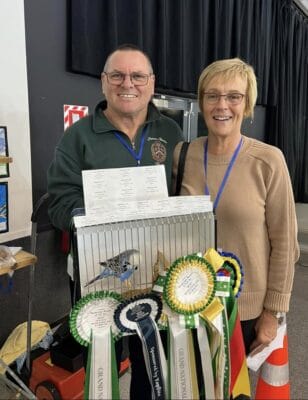
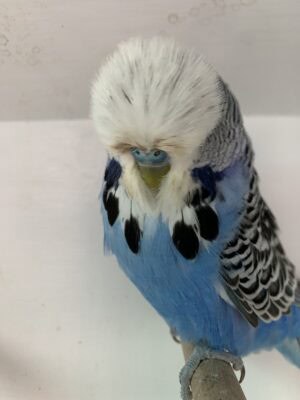
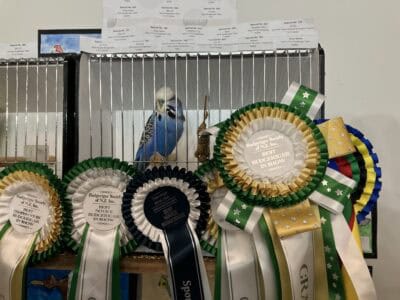
One of my proudest moments came in 2024, when I showed a Cobalt cock at the Auckland Budgie Club’s budgerigar-only show. Looking back to those first pet-shop birds purchased in 2018, the improvement in our birds — and our understanding of how to breed them — has been enormous.
More Than Just Budgerigars
When Anne and I began this journey, we thought we were simply going to breed a few budgies.
Instead, we discovered a hobby filled with genetics, competition, disappointment, excitement, learning and friendships.
The birds themselves are only part of the story.
People such as Dominic Alcock, Vince and Lynne Huston, Geoff Callister, Terry and Linda Patten, Sam Baker, Taryn Hutt and many others have helped us in different ways along the journey. Their willingness to share knowledge reflects one of the best qualities of the budgerigar fancy.
There have been escaped birds, breeding failures, disease outbreaks, too many breeding cages, far too many youngsters and considerably less fishing than I once enjoyed.
But there have also been those mornings when you open a nest box and see a youngster that makes you think, maybe this is the one.
That feeling is still what keeps me coming back.
Larry & Ann Dagg
 |
 |
 |
 |
 |
 |