Australian National Budgerigar Council


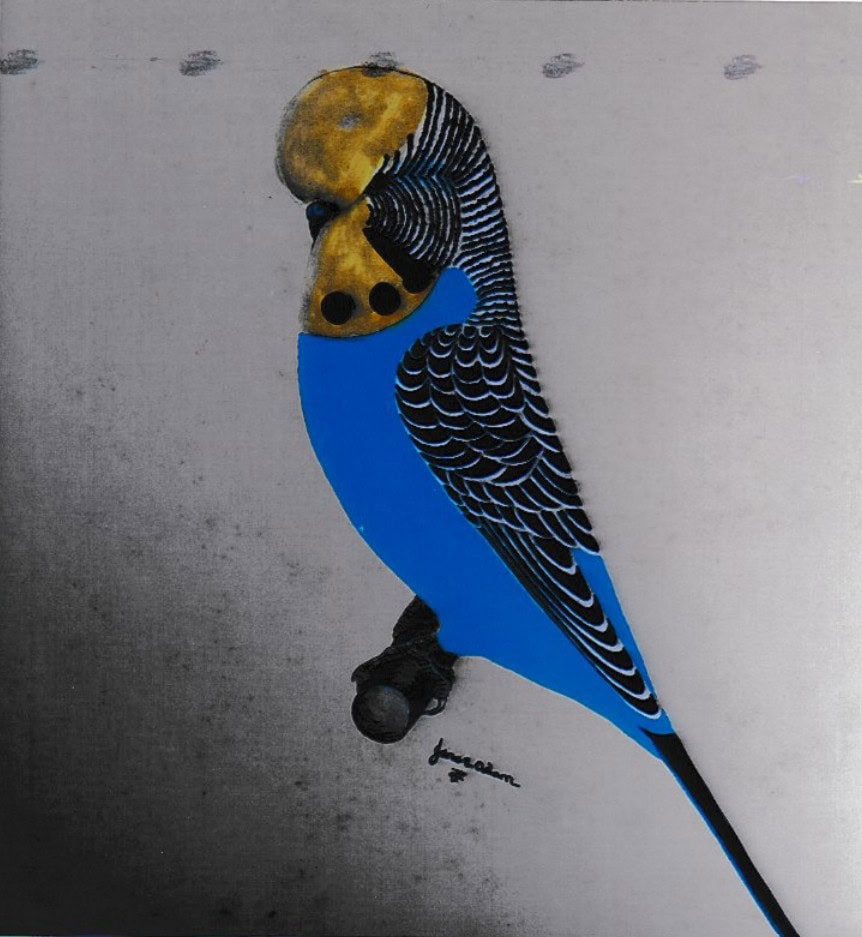
Yellow Faced Blues
Yellow Faced Blues – Dominant or Recessive
Budgerigar fancier Ken Gray poses the question – Yellow Faced Blues, Dominant or Recessive?
Reproduced with permission from Budgerigar World, via Ron Hunt
It is mentioned in various books on Budgerigars that the appearance of Yellow Faced Blues on the show benches in the 1930s caused a great deal of excitement among breeders and exhibitors. One can well imagine why.
Until then the mutations that had occurred, or at least the ones that had been seen in captivity, had been fairly predictable. They had been Dilute forms of the wild-type Light Green giving us Light Yellows, Buttercup Yellows and Greywing Greens; albinism giving us the Lutino; the Dark factor giving us the Dark Greens and in due course Olive Greens and the Blue mutation.
This last mutation, which itself generated quite a stir, produced a bird showing blue where the Green bird showed green and white where the Green bird showed yellow, with the same black or grey markings as the Green, depending on whether it was a Normal or one of the then-known forms of Dilute.
When I say the mutations produced colours or markings which were fairly predictable, I mean that anyone who knows a little of colour theory – knows that yellow and blue mixed produce green.
Therefore, if blue pigment is missing from the Green Budgerigar, theoretically yellow is left, and if yellow is missing from the Green bird, blue should be the visual colour. If the black markings of the Budgerigar are diluted, one could expect them to show as grey.
One can therefore understand why, in the 1930s, a Blue Budgerigar with a yellow mask caused another stir. It did not follow the accepted pattern. True, a mention of a Blue Budgerigar Hen with a yellow head and tail being bred in 1881 had been made, but the mutation does not seem to have been established at that time. So here was a bird that had the blue body of the Blue Budgerigar, but the yellow head and mask of the wild-type Budgerigar.
Other Mutations
Not only that – some Yellow Faced Blue Budgerigars when moulting out at about 12 weeks old took on a greenish appearance, caused by the yellow flooding down from the mask and suffusing the body feathering. This led those who took a special interest in these matters to reach the opinion that there were at least two different Yellow Faced Blue mutations.
Some Budgerigar breeders, even in 1987, still seem to believe that Yellow Faced Blue (including, of course, Grey) Budgerigars are Blue series birds PLUS an additional mutation giving them the yellow head and mask.
Despite plenty of evidence to the contrary, this erroneous idea still seems to be prevalent. One can understand fanciers thinking this when it is believed that ordinary White Faced Blue Budgerigars appeared first in captivity – followed at a later date by the Yellow Faced version. (In actual fact, White Faced Blues and Yellow Faced Blues are reported to have appeared in the same year – 1881.)
The erroneous idea that Yellow Faced Blues are ordinary Blues with the addition of a yellow head and mask, given them by a subsequent mutation may be the reason why some breeders and writers state that Yellow Faced is dominant, and listing Yellow Faced Blues among the dominant varieties.
They are, in fact, nothing of the sort. They are not dominant, except to ordinary White Faced Blue series birds. The relationship is similar in effect to that, say, between Clearwing and Dilute, where we know that Whitewing Blue is dominant to White, but both are recessive to Normal Blue with its black wing markings. I have never heard the Clearwing described as a Dominant mutation.
To be quite clear on this point, we have to define the accepted meaning of the term “Dominant” as applied to genetics, more especially Budgerigar genetics. Those who study these matters know that a dominant mutation, whether it be for a colour or for a special marking, is one that, if paired to a pure Light Green (the colour of the wild-type bird) can produce young of that mutant colour or marking in the first generation.
Well-known examples are Australian Grey (a colour mutation turning an otherwise Blue bird into a Grey, or a Green bird into a Grey Green) and Dominant Pied.
The most common example is that Green can be “split” for Blue, but Blue cannot be “split” for Green. Green can be “split” for any of the Yellow Faced Blue mutant varieties, just as it can be for ordinary White Faced Blue. It hardly needs stating that any individual Green Budgerigar can only be “split” for one of the mutant varieties mentioned – otherwise it would not visually be a Green.
All these facts prove – if proof is necessary – that Yellow Faced Blue mutations cannot truthfully be classified as dominant. All Yellow Faced Blue mutations known in this country – and very likely any others that may have occurred around the world – are recessive to the Green series, as is White Faced Blue.
The mutant genes which cause Blues or Yellow Faced Blues to be produced are all different mutations of the same pair of wild-type (Light Green) genes.
If we accept that ordinary White Faced Blue is a Green bird with the yellow-producing pigment missing, Yellow Faced Blue Budgerigars can be accepted as Green birds with the yellow-producing pigment only partially suppressed, or suppressed in certain areas of the plumage. The amount of suppression and, therefore, the amount of blue feathering, depends on which Yellow Faced Blue mutation it is, and on whether the actual mutant gene has been inherited in just single factor (single dose) or double factor, that is whether from just one or from both parents.
Same Variety
That last part of the last sentence is another peculiarity of the Yellow Faced Blue mutations. It accounts for the different appearance of birds of the same mutant variety depending on whether it has been inherited in single or double factor.
Breeders of Normals – say Normal Greys or Normal Blues – cannot usually detect from the colour of the feathering, whether the bird has inherited just one or both genes for that specific mutant variety. Single factor and double factor birds look alike.
Not so with Yellow Faced Blue mutant varieties. With one mutation it is possible to tell a single factor from a double factor in the nest, while in others it becomes quite obvious only during and after the first moult at about 12 weeks old.
This takes us into another very interesting development of our knowledge of the Yellow Faced Blue mutations – something I will be delving into in a future article.
Editorial comment: As knowledge and understanding advances over time, then we can reinterpret what we see using these early articles as a basis.
For example, we now know there is no blue pigment in the feathers of Blue Budgerigars. The red end of the light spectrum is preferentially absorbed from Incident white light by melanin in the feathers, so the reflected light that we see in a blue budgerigar is the remaining light from the blue end of the light spectrum.
There is a gene in the Green Budgerigar that produces yellow pigment in the feathers when fully functional in its wildtype form. When the above blue light passes through the yellow pigment we see a Green Budgerigar. When the gene that produces this yellow pigment mutated to disable the enzyme that makes the yellow pigment (and this only happened once during evolution) then we see the reflected blue light as a Blue Budgerigar.
There are three other mutations that can affect the same gene that manufactures the yellow pigment in the Green Budgerigar. These mutations affect the amount and distribution of the yellow pigment in different ways. They are responsible for the Golden Faced Blue, Yellow Faced Blue, and White Cap. Explanations for their associated phenotypes are more complicated than for the simple explanations given above for what we see as Green and Blue Budgerigars.
Regarding dominance relationships, green is dominant to all four of the above mutations. Conversely, all four of the above mutations are recessive to green. Golden Faced Blue, Yellow Faced Blue, and White Cap in their Single Factor forms are all visible when associated with the blue mutation as the other member of the genotype, so all are dominant to blue and conversely blue is recessive to all of them. It is more complicated when we intermate Golden Faced Blue, Yellow Faced Blue, and White Cap.
Should we “accept that ordinary White Faced Blue is a green bird with the yellow-producing pigment missing”. Conversely, given the underlying mechanisms now known for producing Green and Blue Budgerigars, why not, instead, regard the green bird as a White Faced Blue with the yellow pigment added? Parrots are the only birds that have harnessed this gene to manufacture yellow, orange and red pigments. So, to take the Yellow Faced Blue budgerigar as an example, should we really consider it as “Green birds with the yellow-producing pigment only partially suppressed”? Why not simply acknowledge that Green, Golden Faced Blue, Yellow Faced Blue, White Cap, and Blue are distinct genetic variations of the same gene that taken together comprise what we know as the Colour Series. All can be associated with all varieties of budgerigar from Normals at the top of The Matrix to Cresteds at the bottom.